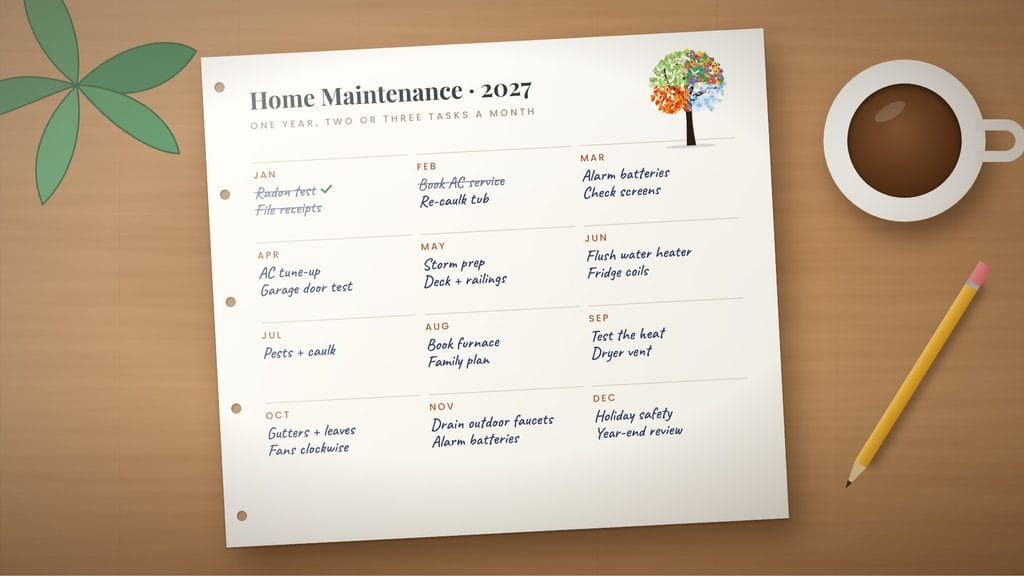
At home, there are two things we do every single year without anyone reminding us: the closet swap when the weather changes, putting away summer clothes and bringing out the winter ones, and a big, thorough clean. Nobody writes them on a calendar. They happen because they are tied to a moment we can’t miss: the first cold mornings, or the feeling that the house needs a reset.
Home maintenance works the same way. The yearly jobs, like servicing the air conditioning, testing for radon or flushing the water heater, are easy to forget because nothing reminds you until something fails. This annual home maintenance calendar gives each of those jobs a month, so the year takes care of itself with two or three tasks at a time.
How this calendar fits with your other routines
Think of home maintenance in three layers:
- Every month: a 30-minute check for leaks, alarms, GFCI outlets and filters. That is our monthly home maintenance checklist, and it is not repeated here.
- Every season: the bigger jobs tied to the weather, like gutters in the fall or protecting pipes before a freeze. They have their own detailed guides, linked in the months below.
- Once or twice a year: the jobs in this calendar. Most of them take an afternoon or a phone call to book a professional.
The months are written for a typical U.S. home with cold winters and warm summers. If you live in the South, on the coast or in the desert, check the climate section near the end and move a few tasks earlier or later.
Your home maintenance year at a glance
| Month | Main tasks |
|---|---|
| January | Test for radon, update your home records, review insurance |
| February | Book spring AC service, re-caulk the tub and shower, plan the year’s repairs |
| March | Change alarm batteries at the time change, check screens and windows |
| April | AC tune-up, start the sprinklers, test the garage door auto-reverse |
| May | Storm and hurricane prep, deck and patio check, ceiling fans on summer mode |
| June | Flush the water heater, clean the refrigerator coils |
| July | Look for pests and wood damage, check exterior caulk and paint |
| August | Book heating and chimney service, update the family emergency plan |
| September | Test the heat before you need it, start the fall exterior work |
| October | Fall exterior checklist, ceiling fans on winter mode |
| November | Freeze protection, alarm batteries at the time change |
| December | Winter and holiday safety, year-end review |
January: test for radon and get your records in order
Test for radon. January is National Radon Action Month, and winter is a good time to test because windows stay closed. Radon is an invisible, odorless gas that comes from the ground, and the EPA calls it the number one cause of lung cancer among non-smokers, responsible for about 21,000 lung cancer deaths a year in the U.S. A short-term test kit costs little at a hardware store and takes a few days. The EPA recommends fixing the home if the result is 4 pCi/L or higher. Renters can test too and share the result with the landlord.
Update your home records. Gather last year’s invoices, warranties and receipts and file them while outdoor work is on pause. If you don’t have a system yet, our guide on how to create a home maintenance binder takes about an hour.
Review your insurance. Read your homeowners or renters policy once a year: check the coverage limits, the deductible and whether anything you bought or improved last year should be added.
February: book early and fix the bathroom seals
Book the spring AC service. Heating and cooling companies fill up quickly once the first hot week arrives. Calling in February usually means a better choice of dates, and sometimes off-season pricing.
Re-caulk the tub and shower. Look at the caulk where the tub meets the tile and around the shower base. If it is cracked, peeling or black in spots that don’t clean off, cut it out and apply a new bead of silicone caulk. It is one of the cheapest ways to keep water out of the walls. Our guide to deep cleaning your bathroom covers how to get the surfaces ready.
Plan the year’s repairs. Make a short list of the bigger jobs you want to do this year, like painting a room or replacing an old appliance, and put a rough budget next to each one. It is easier to save for a repair you saw coming.
March: the time change and the windows
Change the alarm batteries when the clocks change. Daylight saving time starts on the second Sunday of March, and it is an easy reminder: when you change the clocks, change the batteries in any smoke and carbon monoxide alarms that use replaceable ones. Alarms with a sealed 10-year battery only need their monthly test.
Check screens and windows. When you open the windows for the first warm days, look at each screen for tears and each window for cracked glass, broken locks or condensation between double panes, which means the seal has failed. This is a good job to do with the spring closet swap: you are already moving around the house room by room.
Take a post-winter walk outside. Once the snow is gone, look for anything that winter moved or broke: loose siding, a downspout that came off, cracked steps or walkways that could cause a trip.
April: get cooling and outdoor systems ready
AC tune-up. If you booked it in February, this is when it happens. Before the technician arrives, clear leaves and branches from around the outdoor unit and have a new air filter ready.
Start the sprinklers. Only after the last freeze. Turn the system on and run each zone for a couple of minutes while you watch: broken or tilted heads, water hitting the house or the sidewalk and soggy spots all waste water and can damage the foundation.
Test the garage door auto-reverse. An automatic garage door is the heaviest moving object in most homes. The U.S. Consumer Product Safety Commission says the reversing feature should be tested monthly: a closing door must reverse within two seconds after it touches a 2-inch object on the floor. Lay a piece of 2×4 flat under the door and close it. If it doesn’t reverse, disconnect the opener and call a garage door technician. Families with small children should make this a regular habit, not just a spring one.
May: prepare for storm season and summer use
Storm and hurricane prep. If you live near the Atlantic or Gulf coast, the hurricane season starts on June 1. NOAA recommends getting ready before the season begins: ask your insurance company for a check-up and remember that flood insurance usually has a 30-day waiting period, so buying it when a storm is already forecast is too late. Trim weak branches, know how you would secure windows and garage doors, and stock at least three days of food, water and medicine for each person and pet.
Deck, patio and railings. Before summer parties, push on railings and step on every stair. Look for loose boards, popped nails and soft or cracked wood. A railing that moves is a fix for this week, not for later.
Switch the ceiling fans to summer mode. In summer, ceiling fans should spin counterclockwise when you look up at them, so they push air down and create a breeze. There is a small switch on the motor housing; turn the fan off before you change it.
June: two appliance jobs nobody remembers
Flush the water heater. Minerals in the water settle at the bottom of a tank water heater and form sediment. Over time it makes the heater noisy and less efficient and can shorten its life. Most manufacturers recommend draining or flushing the tank once a year, and the exact steps are in your manual. In general: turn off the power or set the gas to “pilot”, connect a hose to the drain valve, run it to a floor drain or outside and let the water run until it comes out clear. The water is hot, so be careful. If the drain valve is stuck or the heater is old and has never been flushed, ask a plumber instead of forcing it.
Clean the refrigerator coils. The coils at the back or bottom of the fridge release heat. When they are covered in dust and pet hair, the fridge works harder in the summer heat. Unplug it, pull it out gently and vacuum the coils with a brush attachment. Five minutes, once a year, and twice if you have pets.
July: look for pests and weather damage
Pests. Summer is when insects and rodents are most active. Walk around the outside and look for wasp nests under the eaves, ant trails into the house, mud tubes on the foundation (a sign of termites) and gaps around pipes and cables where mice could get in. Small gaps can be sealed with caulk or steel wool; termites and large nests are a job for a pest control company.
Exterior caulk and paint. Dry, warm weather is the best time for exterior touch-ups. Look at the caulk around windows and doors and at painted wood that is peeling or soft. Peeling paint often means water is getting behind it, so check the cause before repainting.
August: plan ahead for the cold months
Book heating and chimney service. The same logic as February: book the furnace or heat pump service and, if you use a fireplace or wood stove, the chimney sweep before the first cold week, when everyone calls at once.
Update the family emergency plan. Back-to-school is a natural moment to check that everyone knows two ways out of each room, where to meet outside and who to call. Update the emergency contacts on the fridge and in the kids’ backpacks, and make sure older children know where the main water shutoff is. Our guide on how to find and label your home’s emergency shutoffs makes that easy.
September: test the heat and start the fall work
Test the heat before you need it. On a cool evening, turn the heating on for 15 minutes. A slight dusty smell the first time is normal; a strong burning smell, strange noises or no heat at all are reasons to call while companies still have openings. Put a new filter in before the heating season; our guide on how often to change your HVAC filter explains how to choose one.
Start the fall exterior work. Clean the dryer vent and get the outdoor jobs on the calendar before the leaves fall.
October: the big fall checklist
October is the busiest month of the year for the outside of the house: gutters, roof, trees, leaves and storing the summer gear. Our fall home maintenance checklist covers each job step by step, with a free printable version.
Inside, switch the ceiling fans to winter mode: clockwise at low speed, so they push the warm air that collects near the ceiling back down without creating a draft.
November: protect the house from the cold
Freeze protection. Before the first hard freeze, disconnect the garden hoses, shut off and drain the outdoor faucets and protect exposed pipes. Our guide on how to prepare your home for freezing temperatures explains every step, including what to do if a pipe freezes.
Alarm batteries again. Daylight saving time ends on the first Sunday of November. Same habit as in March: new clocks, new batteries.
December: holiday safety and the year-end review
Winter and holiday safety. Heating, drafts, humidity, the fireplace, space heaters, holiday lights and the tree all come together this month. Our winter home maintenance checklist covers the inside of the house, room by room.
The year-end review. Take 20 minutes with your home records and answer three questions: What broke this year? What did I keep postponing? What needs to be budgeted for next year? Move anything you skipped to next year’s calendar, and remove tasks that don’t apply to your home. After one year, this calendar stops being a generic list and becomes yours.
Adjust the calendar to your climate
| Where you live | What to change |
|---|---|
| Cold North and Midwest | Keep the calendar as it is, but move freeze protection to October if your first frost comes early |
| Hot and humid South | Move the AC service to March, watch humidity and mold all summer, and skip most freeze work |
| Atlantic and Gulf coast | Finish storm prep by the end of May and check for corrosion on outdoor metal after each season |
| Dry West | Clear dry leaves and branches from the roof and around the house before fire season, and check irrigation for leaks in spring |
| Mild Pacific Northwest | Focus on rain: gutters, moss on the roof and moisture inside from fall to spring |
Tie the calendar to things you already do
The reason our closet swap never gets forgotten is that it is attached to something that happens anyway. You can do the same with maintenance:
- Clock changes in March and November: alarm batteries.
- The spring and fall closet swap: windows, screens and ceiling fan direction, since you are already going room by room.
- Your big yearly clean: refrigerator coils, re-caulking the tub and anything else that requires moving things around.
- Back to school: the family emergency plan.
- Tax season or the start of the year: home records and insurance.
Then put the professional appointments (AC in spring, heating in fall) on your phone calendar as yearly repeating events, with a reminder two months before.
If you rent
Most of the professional work in this calendar, like the AC and heating service, the water heater and the roof, is usually the landlord’s responsibility. Your yearly list is shorter: test for radon, change the alarm batteries if they are replaceable, review your renters insurance, clean the fridge coils and switch the fans. For everything else, send a short written reminder to your landlord in February and August asking when the seasonal service is scheduled. Our apartment maintenance checklist for renters explains what is usually yours.
Frequently asked questions
What home maintenance should be done once a year?
The main yearly jobs are servicing the heating and cooling systems, flushing the water heater, cleaning the refrigerator coils and the dryer vent, re-caulking the tub and shower, testing for radon, reviewing insurance and doing the seasonal work on gutters, roof and pipes.
Do I have to start the calendar in January?
No. Start with the current month and keep going. If you are starting in the fall, do the October and November tasks first, since the cold won’t wait.
How many maintenance tasks should I do each month?
Two or three is realistic, plus the short monthly check. Spring and fall are busier; summer and winter are lighter.
What is the difference between monthly and annual home maintenance?
Monthly maintenance is a short check to catch leaks and test safety devices. Annual maintenance is the bigger work done once or twice a year, often by a professional, and timed to the seasons.