Fall is the best season to look after the outside of your home. The weather is mild, the days are still long enough to work outdoors, and anything you find (a loose gutter, a dead branch over the roof, a clogged dryer vent) can be fixed before winter turns it into an emergency. For a first-time homeowner, it is also the season when you learn how your house and your yard really behave.
This fall home maintenance checklist focuses on the outside of the house and the yard: gutters, roof, siding, trees, leaves, the dryer vent, outdoor equipment and lighting. Indoor jobs like the heating, drafts, alarms and the fireplace are in our winter home maintenance checklist, and pipes and outdoor faucets are in our guide on how to prepare your home for freezing temperatures.
When to start fall home maintenance
Start after the summer heat and finish before the first freeze in your area. In northern states that usually means September and October; in milder climates, October and November. Gutters are the exception: clean them after most of the leaves have fallen, or you will do the job twice.
You don’t need to do everything in one weekend. Split the list into two or three sessions, and write down what needs a professional so you can book them before they get busy.
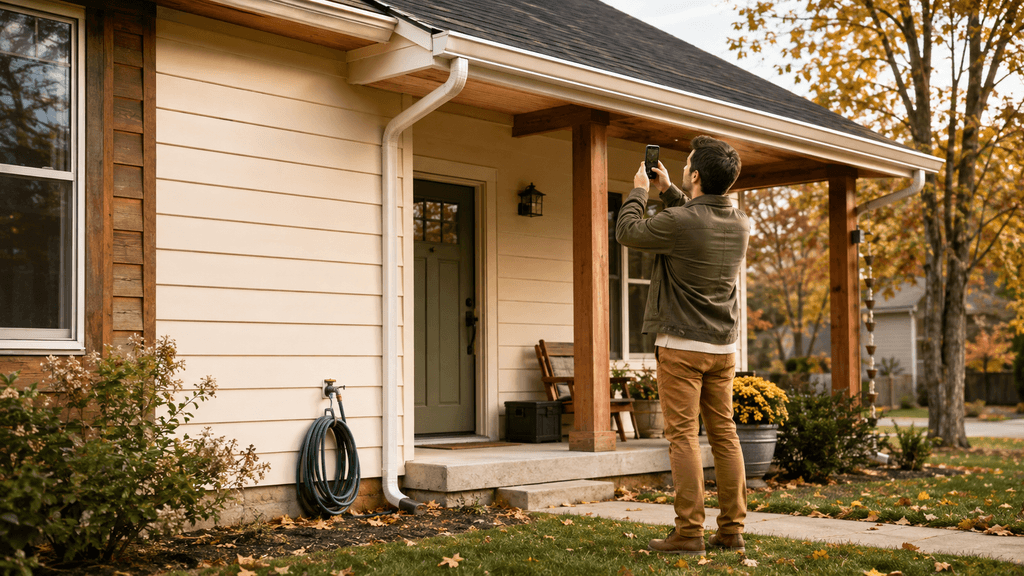
Fall home maintenance checklist at a glance
| Task | When | DIY or pro? |
|---|---|---|
| Clean gutters and check downspouts | After most leaves fall | DIY from a safe ladder; pro for high roofs |
| Inspect the roof from the ground | Early fall | DIY; pro if you see damage |
| Check siding, exterior caulk and openings | Early fall | DIY |
| Look for hazardous trees and branches | Early fall | DIY to spot; arborist to remove |
| Deal with fallen leaves | Weekly during leaf fall | DIY |
| Clean the dryer vent | Once a year | DIY or pro |
| Store outdoor furniture, grill and garden tools | Before the first frost | DIY |
| Prepare the lawn mower for storage | After the last mow | DIY |
| Check outdoor lights, steps and railings | Before the clocks change | DIY |
| Test the sump pump, if you have one | Before the fall rains | DIY |
1. Clean the gutters and check the downspouts
Gutters full of leaves overflow onto the siding and the foundation, and in winter they help ice dams form. Scoop out the debris by hand with gloves, then run water from a hose to check that it flows to the downspouts. Each downspout should end at least a few feet away from the house; a simple extension or splash block fixes most short ones. Watch for gutters that sag or pull away from the fascia: they need new hangers.
Gutter cleaning is the job that sends most people up a ladder, so do it safely. The Consumer Product Safety Commission recommends having someone spot you, setting the ladder on stable ground, never standing on the top rung and keeping the ladder away from power lines. It also notes that adults 65 and older are 80% more likely than other adults to visit an emergency room for ladder injuries. If the gutters are on the second floor or you are not comfortable on a ladder, hire someone: it is usually a short, affordable job.
2. Inspect the roof from the ground
You don’t need to climb on the roof. Walk around the house with binoculars or your phone’s zoom and look for:
- Missing, cracked, curled or lifted shingles.
- Damaged or loose flashing around the chimney, vents and skylights.
- Moss, or piles of leaves and branches in the valleys where two slopes meet.
- Granules from the shingles collecting at the end of the downspouts, a sign of an aging roof.
Then look inside: a new stain on a ceiling after rain means water is getting in somewhere. Take photos of anything you find and call a roofer before winter; small repairs are much cheaper than a leak in January.
3. Check siding, exterior caulk and openings
Walk around the outside of the house slowly, at eye level and at the base of the walls. Look for cracked or missing caulk around windows and doors, gaps where pipes, cables and vents enter the house, loose or damaged siding, and peeling paint on wood trim, which lets water into the wood. These gaps let in water, cold air and, as the weather cools, mice and insects looking for a warm place.
Use exterior-grade caulk for small cracks around frames, and foam or a cover plate for larger openings around pipes. Leave weep holes at the bottom of window frames and siding open: they are there to let water out. Wood rot that is soft when you press it with a screwdriver needs a carpenter.
4. Look for hazardous trees and branches
Fall and winter storms bring down weak branches, and snow adds weight. Before winter, look at the trees near the house, the driveway and the power lines. The University of Florida’s IFAS Extension lists the warning signs of a tree that may be a risk to your home:
- Dead branches with no bark or leaves, and broken branches still hanging in the tree.
- Fungus or mushrooms growing on the trunk or around the base, and cavities that suggest internal decay.
- Two main trunks growing from the same point in a tight “V” shape, which splits more easily than a wide “U”.
- A tree that has started to lean, especially if it happened recently.
If you see any of these, the same Extension recommends calling an ISA Certified Arborist. Never cut branches near power lines yourself; call the utility company.
5. Deal with fallen leaves
A thick layer of wet leaves smothers the grass and makes paths slippery. You don’t always need to rake and bag them. Kansas State University Extension recommends mulch mowing: mowing over a thin layer of leaves, about an inch, so the mower chops them into small pieces that return nutrients to the soil. For heavy leaf fall, mow once without the bag to shred them, then a second time with the bag to collect them; the shredded leaves take up much less space.
Keep leaves away from storm drains, window wells and the base of the house, and use the collected ones as mulch around shrubs or in the compost.
6. Clean the dryer vent
This one is easy to forget and important. According to the U.S. Fire Administration, there are an estimated 2,900 clothes dryer fires in homes every year, and failure to clean is the leading cause (34%). In winter, the dryer runs more and the house is closed, so fall is the right time:
- Clean the lint filter after every load, if you don’t already.
- Unplug the dryer, pull it out and disconnect the duct. Use a dryer vent brush kit to clean the duct and the opening in the wall.
- Go outside and check the vent cover: the flap should open when the dryer runs and close when it stops, with no lint or nests blocking it.
- Replace plastic or foil accordion ducts with a rigid or semi-rigid metal duct, as most dryer manuals recommend.
If clothes take longer than usual to dry or the outside of the dryer gets very hot, the vent is probably blocked. For long ducts or vents on the roof, hire a dryer vent cleaning service.
7. Put away outdoor furniture, the grill and garden tools
- Furniture and cushions: clean them, let them dry completely and store them in the garage or shed, or cover them. Wet cushions stored in a closed space grow mold.
- Grill: clean the grates and the grease tray. Propane tanks stay outside, never in the garage or the house, upright and with the valve closed.
- Garden tools: clean the soil off, dry them and hang them, so the metal doesn’t rust over the winter.
- Lawn mower: after the last mow, follow the manual to prepare it for storage. Most recommend either adding a fuel stabilizer or running the engine until the tank is empty.
8. Check outdoor lights, steps and railings
Days get shorter fast in fall, and when the clocks change in November, you will come home in the dark. Replace burned-out bulbs at the entrance, the driveway and the garage, and consider a timer or motion sensor. Tighten loose handrails, and fix uneven pavers or loose boards on steps and decks before they are wet and covered in leaves. Every outdoor step should have a handrail you can trust in ice and snow.
9. Test the sump pump before the fall rains
If your home has a basement with a sump pump, test it before the rainy season: slowly pour a bucket of water into the pit. The pump should turn on, empty the pit and switch off. Check that the discharge pipe outside is not blocked by leaves and drains away from the house. If the pump doesn’t start, call a plumber before the next big storm.
When to call a professional
Call a professional for anything on the roof, gutters you can’t reach safely from the ground or a short ladder, trees near power lines or large dead branches, soft or rotten wood, and any sign of water coming into the house. Fall is a good time to book them: in winter, roofers and tree services are busy with storm damage.
Write down what you checked and what you hired out. A home maintenance binder keeps the dates and invoices together, so next fall you will know exactly where to start. If you are in your first months in the home, our first 30 days in a new home checklist covers what to do before this list.
Frequently asked questions
What should I do first in fall home maintenance?
Start with what needs a professional, like a roof repair or a tree removal, so you can book it early. Then do the tasks that protect against water: gutters, downspouts and exterior caulk.
How often should I clean my gutters?
At least twice a year, in late spring and in late fall after most leaves have fallen. Homes surrounded by trees may need it more often.
How often should a dryer vent be cleaned?
Clean the lint filter after every load and the vent duct at least once a year, or sooner if clothes take longer to dry. Fall is a good time, before the heavy winter use.