For years my home maintenance plan was simple: wait until something broke, then fix it. It worked until the day we found a leak under the sink. It had been dripping slowly for who knows how long, and by the time anyone noticed, the bottom of the cabinet was already damp and swollen. A two-minute look once a month would have caught it while it was still a loose connection and a towel.
That is what this monthly home maintenance checklist is for. It is not a weekend of chores. It is a 30-minute walk through the house, always in the same order, to catch leaks, test the safety devices and notice small changes before they turn into repairs. Below you will find the full checklist, what to look for in each step and what to do when you find something.
The monthly home maintenance checklist at a glance
| Task | Time | What you are looking for |
|---|---|---|
| 1. Look under every sink | 5 min | Drips, damp cabinet floor, swollen wood, musty smell |
| 2. Check the toilets | 3 min | Running water, wobbling, damp floor at the base |
| 3. Look around water appliances | 4 min | Puddles, rust, bulging hoses near the washer, dishwasher, fridge and water heater |
| 4. Test smoke and CO alarms | 3 min | A loud alarm on every unit, no end-of-life warnings |
| 5. Test the GFCI outlets | 3 min | Power cuts on TEST and comes back on RESET |
| 6. Check the HVAC filter | 2 min | A gray, dusty filter that needs changing |
| 7. Clean the kitchen filters | 5 min | Greasy range hood filter, food in the dishwasher filter |
| 8. Check the fire extinguisher | 1 min | Gauge in the green, easy to reach, no damage |
| 9. Walk around the outside | 4 min | Loose downspouts, water by the foundation, debris around the AC unit |
The times are for an average apartment or small house once you know the route. The first month will take longer because you are finding where everything is.
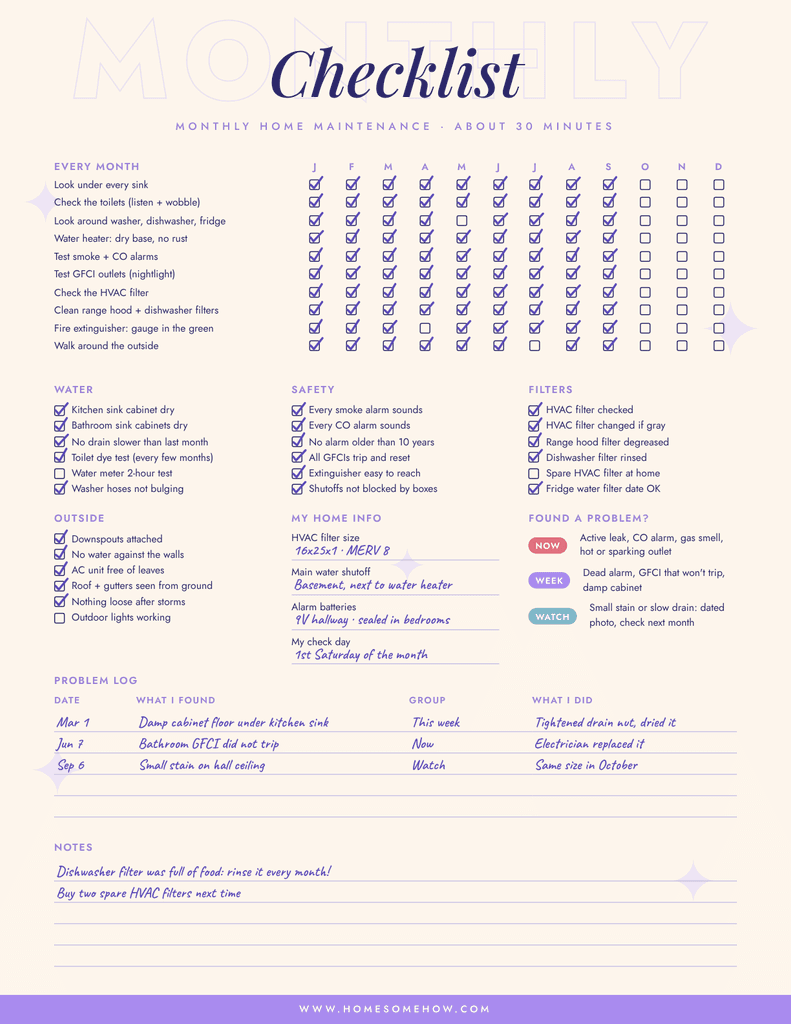
Here is what the checklist looks like after nine months of use. Each row is one monthly check, so a blank box shows at a glance which tasks you keep skipping. The problem log keeps a dated record of what you found and how you fixed it, which is useful when you call a plumber, file an insurance claim or talk to your landlord. The “My home info” box saves the filter size and the shutoff location, so you never have to look for them again. Below the example you can download a clean, blank version as a free PDF to print and keep with your flashlight.
Why a monthly check is worth 30 minutes
Most expensive home problems start small and quiet. According to the EPA’s WaterSense program, household leaks can waste more than 9,300 gallons of water a year in the average home, and fixing easy leaks can cut a water bill by about 10 percent. A slow drip under a sink does not make noise, and a cabinet does not complain until the wood is ruined.
Safety devices are the other reason. A smoke alarm with a dead battery looks exactly like one that works. The only way to know is to test it.
1. Look under every sink
This is the step I would never skip after our experience. Open the cabinet under the kitchen sink and every bathroom sink, move anything that blocks the view and use a flashlight. Check:
- The pipes and the connections to the faucet and the shutoff valves.
- The cabinet floor: run a dry paper towel over it. If it comes out damp, something is leaking.
- Swollen, soft or stained wood, and any musty smell.
- The garbage disposal, if you have one: water on its body or underneath.
If you find water, dry it quickly. The EPA notes that when wet materials are dried within 24 to 48 hours, in most cases mold will not grow. Put a container under the drip, take a photo and find the source. A slip nut on the drain can often be tightened by hand; a leak at a supply line or valve is a job for a plumber. Keep cleaning products in a tray or bin under the sink, so a new leak is easy to spot and does not soak everything.
A slow drain is worth noting too. If the kitchen sink takes longer to empty every month, our guide on how to deep clean a greasy kitchen and unclog a slow sink explains how to clear it without harsh chemicals.
2. Check the toilets
Listen after each toilet refills: you should hear nothing. A faint hiss or a tank that refills on its own every few minutes means water is leaking into the bowl. The EPA suggests a simple test: put a few drops of food coloring in the tank and wait about 10 minutes without flushing. If color shows up in the bowl, there is a leak, and flush right away so the dye does not stain. Our guide on how to fix a running toilet walks you through the most common causes.
Then gently push the toilet from side to side. It should not move. Also look at the floor around the base and the supply hose behind it. A wobble or a damp floor can mean the seal under the toilet is failing, and that water goes into the subfloor where you cannot see it.
Once every few months: try the water meter test. Turn off every tap and appliance that uses water, read the meter, and read it again two hours later. If the number changed, the EPA says you probably have a leak somewhere in the system.
3. Look around the appliances that use water
You don’t need to pull anything away from the wall. Look at what you can see:
- Washing machine: the hoses behind it should not be cracked, bulging or wet. Rubber hoses age; if yours are old, braided stainless steel hoses are an inexpensive upgrade.
- Dishwasher: the floor in front of it and the kick plate at the bottom should be dry after a cycle.
- Refrigerator: if it has an ice maker or water dispenser, check the floor around it for water.
- Water heater: look at the base and the floor for water or rust. Leave anything involving gas, the vent or the relief valve to a professional.
If you have never located your main water shutoff, do it now, before you need it. Our guide on how to find and label your home’s emergency shutoffs shows where to look.
4. Test the smoke and carbon monoxide alarms
Press and hold the test button on every alarm until it sounds. Warn the rest of the household first, and cover your ears: it is loud on purpose. If an alarm is weak, silent or chirping, change the battery or, if it has a sealed battery, replace the whole unit. Most alarms have a manufacture date on the back; smoke alarms should be replaced 10 years after that date.
Carbon monoxide has no smell, so the alarm is your only warning. The U.S. Consumer Product Safety Commission recommends CO alarms on every level of the home and outside sleeping areas, and reports that more than 200 people in the U.S. die every year from accidental CO poisoning linked to consumer products. If a CO alarm goes off for real, get everyone outside and call 911 from there.
If you have kids, let them press the test button with you. It is the best way for them to learn what the alarm sounds like and that it means going outside.
5. Test the GFCI outlets
GFCI outlets are the ones with TEST and RESET buttons, usually in the kitchen, bathrooms, laundry room, garage and outside. They cut the power in a fraction of a second if electricity starts going where it should not, like through water or a person. The Electrical Safety Foundation International recommends testing them every month with a simple routine:
- Press RESET and plug in a nightlight. It should turn on.
- Press TEST. The nightlight should turn off.
- Press RESET again. The nightlight should come back on.
If the light stays on after you press TEST, the outlet is not protecting you. Stop using it and call an electrician. One GFCI can protect other outlets on the same circuit, so if an outlet in the bathroom has no power, check for a tripped GFCI before anything else.
6. Check the HVAC filter
Pull the filter out and hold it up to a light. If you can barely see light through it, or it is gray and covered in dust, change it. Checking monthly does not mean changing it monthly: how fast it gets dirty depends on the filter, pets, the season and how much the system runs. Write the filter size on the frame of the return grille or on your phone, so you never have to take it out at the store. Our guide on how often to change your HVAC filter explains how to find the right interval for your home.
7. Clean the kitchen filters
Two small filters in the kitchen are easy to forget and make a big difference:
- Range hood filter: if you cook often, grease builds up quickly and the fan stops pulling smoke. Most metal filters can soak in hot water with dish soap and a little baking soda.
- Dishwasher filter: many newer dishwashers have a manual filter at the bottom. Twist it out, rinse it under the tap and put it back. If dishes come out gritty or the machine smells, this is usually the reason.
Check your manuals for the exact steps; some appliances have their own filter schedule.
8. Check the fire extinguisher
If you have one, this takes a minute. The U.S. Fire Administration advises checking that the extinguisher is easy to reach, that the gauge shows the right pressure and that the can, hose and nozzle are not damaged or rusted. Some models also need to be shaken monthly; the label tells you. Keep it near an exit from the kitchen, not behind the stove where you would have to reach through the fire.
9. Take a quick walk around the outside
This is a look, not a project. Walk around the house and check that downspouts are attached and pointing away from the foundation, that no water is pooling against the walls, that the outdoor AC unit is free of leaves and branches, and that nothing has come loose after a storm. Look at the roof and gutters from the ground only.
If you see something that needs real work, like gutters full of leaves, it goes on the seasonal list. Our fall home maintenance checklist covers the big outdoor jobs.
What happens when you find a problem
Finding something is the point of the routine, not a failure. Sort each problem into one of three groups:
| Group | Examples | What to do |
|---|---|---|
| Now | Active leak, CO alarm going off, smell of gas, outlet that sparks or feels hot | Shut off the water or power if it is safe, leave if needed, call the utility, 911 or a professional |
| This week | Dead alarm, GFCI that does not trip, wobbling toilet, damp cabinet floor | Fix it yourself if it is simple, or book the repair |
| Watch | A small stain that is not growing, a drain that is a bit slow | Take a dated photo and check it again next month |
The “watch” group only works if you actually look again. If the stain is bigger next month, it moves to “this week”.
What you do not need to do every month
A monthly list becomes impossible when it tries to include everything. These jobs matter, but they belong to a season or a yearly schedule, not to this routine: cleaning gutters, flushing the water heater, cleaning the dryer vent, servicing the furnace or AC, cleaning the refrigerator coils and inspecting the roof up close. Our annual home maintenance calendar places each of them in the right month.
How to actually remember to do it
My system used to be my memory, and my memory only remembered home maintenance when something was already wrong. What makes a monthly routine work is taking the decision out of your head:
- Pick a fixed day, like the first Saturday of the month or the day you pay the rent or mortgage, and put a repeating reminder on your phone.
- Follow the same route every time: kitchen, bathrooms, laundry, hallway alarms, outside. After two or three months you won’t need the list.
- Keep a flashlight, a nightlight for the GFCI test and a pen in one place, so you don’t spend the first ten minutes looking for them.
- Write one line with the date and anything you found. A home maintenance binder or a note on your phone is enough.
- Share it. If you live with other people, split the route: one person takes the water checks, the other the alarms and outlets.
If you rent
The same checks apply, but the next step is different. Your job is to notice and report; the landlord’s job is usually to repair. Send every problem in writing, by email or through the tenant portal, with a photo and the date. That record protects you if a slow leak causes damage later, and it helps when you get your deposit back. You can still change the batteries in alarms, clean the kitchen filters and change the HVAC filter if your lease says so. Our apartment maintenance checklist for renters explains what is usually yours and what is not.
Frequently asked questions
What home maintenance should be done every month?
Check under sinks and around toilets and water appliances for leaks, test smoke and carbon monoxide alarms, test GFCI outlets, check the HVAC filter, clean the range hood and dishwasher filters, check the fire extinguisher and take a short walk around the outside.
How long does monthly home maintenance take?
About 30 minutes in an average home once you know the route. The first time takes longer because you are finding the filters, outlets and shutoffs.
Do I need to change the HVAC filter every month?
Not always. Check it every month and change it when it looks dirty. With pets, allergies or heavy heating and cooling use, that may be monthly; in other homes it can last longer.
Is monthly home maintenance different from seasonal maintenance?
Yes. Monthly maintenance is a short check to catch changes early. Seasonal maintenance is the bigger work tied to the weather, like gutters in the fall or protecting pipes before a freeze.