A bathroom can look clean and still hold soap film on the shower door, dust in the exhaust fan, hair in the drawers and grime around the base of the toilet. A quick clean takes care of what you see. To deep clean a bathroom, you go after the buildup and the places that are easy to ignore, in an order that stops you from cleaning the same spot twice.
This guide gives you that order, the time each step takes, what to use on each surface and the mistakes that damage finishes. For an average bathroom, plan on about 90 minutes.
Deep cleaning vs. regular cleaning vs. disinfecting
Regular cleaning covers the toilet bowl, sink, counter, mirror and floor. A deep clean includes those, plus the shower-door track, the exhaust fan cover, the edges of the tub, the drawers, under the sink and the floor behind the toilet. Most people deep clean their bathroom once a month; see our monthly deep cleaning checklist for the rest of the house.
Cleaning and disinfecting are not the same thing. The CDC explains that cleaning with soap, water and scrubbing removes most germs and dirt, while disinfecting uses chemicals to kill germs. It recommends disinfecting mainly when someone at home is sick or at higher risk, not as a routine on every surface. So a deep clean is mostly about cleaning well; disinfecting is an extra step when you need it.
What you need to deep clean a bathroom
You do not need a cupboard full of products. This covers almost every bathroom:
- Vacuum with a crevice tool and a brush attachment
- 4–6 microfiber cloths, ideally in two colors: one color only for the toilet
- Non-scratch sponge and a small stiff brush (an old toothbrush works) for grout, tracks and faucets
- Squeegee for the shower glass
- Toilet brush and toilet bowl cleaner
- All-purpose bathroom cleaner that is safe for your surfaces, plus dish soap and baking soda
- A hard-water or limescale remover, only if you have white mineral spots and your surfaces allow it
- Gloves and a mop or floor cloth
Three safety rules before you start
- Never mix cleaning products. Bleach combined with ammonia releases toxic chloramine gases, and bleach combined with acids such as vinegar or toilet bowl cleaner releases chlorine gas (Washington State Department of Health). If you switch products on the same surface, rinse in between.
- Ventilate. Turn on the exhaust fan and open a window or the door while you work.
- Check the surface before you use anything acidic. Vinegar and many limescale removers can etch marble, travertine and limestone (Natural Stone Institute).
How to deep clean a bathroom: the right order
Three rules decide the order: top to bottom so dirt falls onto areas you have not cleaned yet, dry before wet so hair and dust do not turn into paste, and cleanest to dirtiest so the toilet comes after the sink.
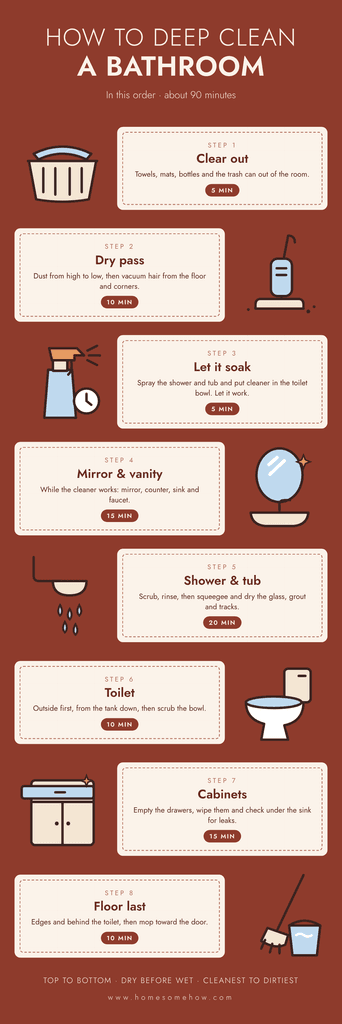
Times are estimates for an average bathroom.
Step 1: Clear everything out (5 minutes)
Take out the bath mat, towels, trash can, scale and anything on the floor. Empty the shower of bottles and razors and clear the counter completely instead of pushing things from one side to the other. Put the towels and mat in the wash.
Step 2: Dry pass, top to bottom (10 minutes)
Before anything gets wet, dust the top of the door frame, light fixtures you can reach safely, shelves and the outside of the exhaust fan cover. Vacuum the fan cover with the brush tool, then vacuum the floor, corners, the gap behind the toilet and the base of the vanity. Dry hair is easy to vacuum; wet hair sticks to everything.
Step 3: Apply cleaner and let it soak (5 minutes)
Spray the shower walls, tub and glass with a cleaner that suits the surface, and put toilet bowl cleaner under the rim. Then walk away. Most cleaners need a few minutes of contact time to loosen soap film, so let them work while you do step 4. Do not let them dry on the surface.
Step 4: Mirror, counter, sink and faucet (15 minutes)
- Mirror: spray the cleaner onto the cloth, not the mirror, wipe top to bottom, then buff with a second dry cloth. Streaks almost always mean too much product or a dirty cloth.
- Sink and faucet: scrub the basin and the overflow hole, then use the small brush around the base of the faucet and handles, where buildup hides. Pull out the sink stopper if it lifts out easily and remove the hair.
- Counter and cabinet fronts: wipe the backsplash, the counter edge and the handles. Finish with a clean, damp cloth so you do not leave residue.
Step 5: Shower and tub (20 minutes)
Scrub from top to bottom with the non-scratch sponge, paying attention to corners, ledges, the underside of shelves and the line where the walls meet the tub or shower floor. Use the small brush on grout. Rinse well, because cleaner left on the floor makes it slippery and dull. Finish with the glass (next section) and dry everything with the squeegee and a cloth.
Step 6: Toilet (10 minutes)
Use your toilet-only cloth. Clean from the cleanest part to the dirtiest: tank lid, tank, flush handle, lid, both sides of the seat, hinges, outside of the bowl, then the base and the floor around it. Last, scrub the bowl, which has had the cleaner sitting in it since step 3, and flush.
Step 7: Drawers and under the sink (15 minutes)
Empty one drawer at a time, vacuum out hair and dust, wipe it and throw away expired products and empty bottles. Under the sink, take everything out and look for water stains, a soft cabinet floor or a musty smell, which can mean a slow leak. Stand bottles in a tray or shallow box so a spill does not reach the cabinet base.
Step 8: Floor last (10 minutes)
Wipe the baseboards and the edges first, including behind the toilet, then mop from the far corner toward the door so you do not walk over the clean floor. Let it dry before you put the mat back.
How to remove marks from shower glass
Look at the marks before you choose a product, because different marks need different treatments:
| What you see | What it usually is | What to try |
|---|---|---|
| Greasy, smeary film | Soap scum and body oils | Warm water with dish soap and a non-scratch sponge, then rinse |
| White spots or chalky haze | Hard-water minerals | A limescale remover safe for glass, or diluted white vinegar if nothing nearby is natural stone |
| Pink, orange or black marks on seals and caulk | Mold or bacteria that grow where it stays damp | Scrub with detergent and water and dry completely; improve ventilation |
| Cloudy even when completely clean and dry | Etched glass | Cleaning will not fix it; it is damage, not dirt |
After cleaning, always squeegee the glass and dry the edges. Water that evaporates on the glass leaves new mineral spots behind, so drying is what keeps it clear.
What to use on each bathroom surface
| Surface | Safe start | Avoid |
|---|---|---|
| Acrylic or fiberglass tub and shower | Mild bathroom cleaner or dish soap, soft cloth | Scouring powder, abrasive pads, stiff brushes |
| Porcelain or enamel tub | Non-abrasive cleaner, soft sponge | Steel wool and metal scrapers, which can chip it |
| Ceramic tile | All-purpose bathroom cleaner | Wire brushes on the grout |
| Grout | Baking soda paste and a small stiff brush | Scrubbing crumbling grout; it needs repair, not cleaning |
| Marble, travertine, limestone | pH-neutral stone cleaner | Vinegar, lemon, bleach and most limescale removers |
| Chrome faucets | Dish soap, then dry with a cloth | Abrasive pads |
| Matte black, brass or nickel faucets | Mild soap and water only, unless the manufacturer says otherwise | Acidic or abrasive cleaners |
| Painted or wood vanity | Damp cloth with a little soap, then dry | Soaking the seams or letting water pool |
When in doubt, check the manufacturer’s care guide and test on a hidden spot first.
Problem areas: grout, showerhead, mold and toilet rings
- Dark grout: scrub with baking soda paste and a small brush, rinse and let it dry before you judge the result. Grout that stays dark when dry is stained, not dirty. Crumbling grout or gaps are a repair job.
- Clogged showerhead: white crust around the nozzles is mineral buildup. Many plastic-faced showerheads have rubber nozzles you can rub with your finger to break the deposits loose. Only soak a showerhead in vinegar if its care instructions allow it, because some finishes can be damaged.
- Mold on caulk or ceiling: the EPA advises scrubbing mold off hard surfaces with detergent and water and drying them completely, and warns not to paint or caulk over mold. If the moldy area is larger than about 10 square feet, it recommends getting professional help. Mold that keeps coming back means the bathroom stays too damp.
- Ring in the toilet bowl: let the toilet bowl cleaner sit for the full time on the label, then scrub. A ring that will not move is usually mineral buildup and needs a limescale product made for toilets.
If you need to disinfect
When someone has been sick, disinfect the high-touch spots after cleaning: flush handle, toilet seat, faucet handles and door handle. The step most people skip is contact time: the EPA explains that the surface should stay wet for the whole time listed on the label for the product to work. Spraying and wiping straight away does not disinfect. Clean first, because dirt stops the disinfectant from reaching the germs.
How to keep it clean after a deep clean
- Run the fan for 20 minutes after every shower, as the Home Ventilating Institute recommends. Less moisture means less mold and fewer mineral spots.
- Squeegee the shower glass after each shower. It takes 30 seconds and saves most of the scrubbing.
- Keep the counter clear. Every bottle you put away is one less thing to move next time.
- Do a 10-minute weekly clean: toilet, sink, mirror and floor. See how it fits into our realistic weekly cleaning schedule.
Common mistakes when you deep clean a bathroom
| Mistake | What happens | Do this instead |
|---|---|---|
| Spraying before vacuuming | Hair and dust turn into sticky paste | Always do the dry pass first |
| Wiping the cleaner off immediately | The cleaner has no time to work, so you scrub twice as hard | Let it sit for the time on the label |
| Using one cloth for everything | Germs from the toilet end up on the sink | A separate cloth color for the toilet |
| Using vinegar on stone | Dull, etched spots that do not come out | pH-neutral stone cleaner |
| Leaving the shower wet | New mineral spots and mold | Squeegee and dry, run the fan |
| Mixing products to make them “stronger” | Toxic gases | One product at a time, rinse in between |
Frequently asked questions
How often should you deep clean a bathroom?
Once a month works for most homes, with a quick clean once a week. A bathroom used by several people, or one with hard water, may need a deep clean every two to three weeks.
How long does it take to deep clean a bathroom?
About 90 minutes for an average bathroom with a shower or tub, following the order above. A small half-bath can take 30–40 minutes; a large bathroom with a separate tub and shower can take two hours.
What is the best order to deep clean a bathroom?
Clear out, dust and vacuum while everything is dry, apply cleaner to the shower and toilet to soak, clean the mirror and sink, scrub the shower and tub, clean the toilet, then the drawers and under the sink, and finish with the floor.
Is vinegar safe for every bathroom surface?
No. Vinegar is acidic and can etch natural stone such as marble, travertine and limestone, and it can damage some faucet finishes. Never mix it with bleach.
Do I need to disinfect the whole bathroom every time?
No. Thorough cleaning is enough most of the time. The CDC recommends disinfecting mainly when someone in the home is sick or at higher risk.