A realistic weekly cleaning schedule has to work on the days you come home tired, not only on calm weeks. If it needs an hour every evening, it will last until the first busy Wednesday. What works for working adults and busy families is the opposite: a few short sessions, a clear order of priorities and a plan for the days when nothing gets done.
Time is the real problem. According to the American Time Use Survey 2025, women who did household activities on a given day spent an average of 2.8 hours on them, and men 2.1 hours (that includes cooking and household management, not only cleaning). The schedule below keeps cleaning to about 15 minutes on most days.
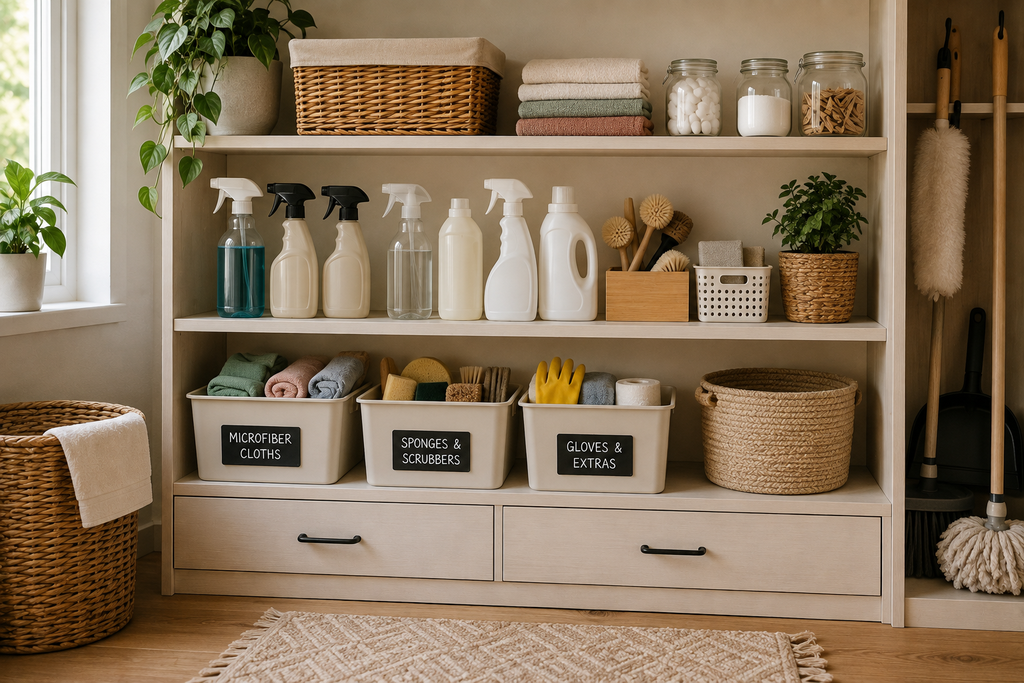
The simple weekly cleaning schedule
The idea is one small focus per day instead of everything at once. The last column is the version for bad days: doing that much still counts.
| Day | Focus | Normal day (15–20 min) | Bad day (5 min) |
|---|---|---|---|
| Monday | Bathroom | Toilet, sink, mirror, quick wipe of the shower | Toilet and sink |
| Tuesday | Dust and surfaces | Dust the furniture you use, put things back in their place | Clear the dining table and coffee table |
| Wednesday | Floors | Sweep or vacuum and mop the kitchen, hallway and living room | Kitchen floor only |
| Thursday | Kitchen | Counters, stove, sink, appliance handles | Sink and counters |
| Friday | Bathroom (quick) | Toilet, sink and mirror | Toilet only |
| Saturday | Sheets and catch-up | Change the bed linens and do the one task you skipped this week | Sheets only, or nothing |
| Sunday | Kitchen reset | Kitchen ready for Monday, trash out | Trash out |
Notice that the kitchen and the bathroom come up twice, with three or four days in between: the bathroom on Monday and Friday, the kitchen on Thursday and Sunday. They are the rooms that get dirty fastest, so they need it most.
A weekly cleaning schedule without fixed days
I study and work, so I don’t clean on fixed days. What I do is clean the kitchen and the bathroom twice a week, leaving three or four days between one clean and the next, and I fit it in whenever I can. If your week changes a lot, that rhythm works better than a calendar you cannot keep.
The trick that makes it happen is choosing the moment, not the day. I clean right before I sit down to rest, for example before lunch. Once I am on the sofa, I am not getting up again. Pick a moment that already exists in your day: before lunch, as soon as you get home, while the pasta water boils. That moment does the job a schedule on paper cannot.
The 10-minute daily minimum
Whatever schedule you follow, a few small things every day keep the week under control:
- Leave the kitchen usable after the last meal: dishes in the dishwasher or washed, counters wiped.
- Clean spills when they happen, while they are still easy.
- Put back the things that are out of place in the living areas.
- Take out the trash when it is full.
Set a timer for 10 minutes if tasks tend to grow, and stop when it rings. If you want a set routine for this, our 15-minute nightly reset explains it step by step.
Laundry: little and often
Laundry piles up faster than anything else. My brother and I live together and we run a load about every two days. It sounds like a lot, but each load is small, it dries quickly and we never end up with a mountain of clothes to fold on Sunday. In a bigger household, a load a day works the same way.
If you have children
Parents are often the most overwhelmed, and the numbers show why. The same American Time Use Survey found that adults in households with children under 6 spent an average of 2.3 hours a day on primary childcare, on top of work and housework. A schedule that ignores that time will not last a week.
The structure above still works, with a few changes:
- Lower the bar for the living areas. With small children, the goal is a safe, usable home, not a tidy one at every hour. Keep the kitchen, the bathroom and the floors where they play under control, and let the rest wait.
- Find your moment. For many parents it is the 15 minutes after the children go to bed, or while they have a bath or a snack at the table.
- Do a five-minute toy reset before dinner, together. A basket per room makes it fast, and the floor is ready for the evening.
- Run a load of laundry every day. With children, waiting for the weekend means a mountain.
- Give children real jobs. The American Academy of Pediatrics suggests that children aged 5 to 7 can make their beds, set and clear the table, dust and put toys away; from 8 to 10 they can vacuum and put away their own laundry and the groceries; and from 11 to 12 they can clean the kitchen, change the sheets, do the laundry and clean the bathroom.
Their help will not be perfect at first. Accept it anyway: a table set a bit crooked still saves you five minutes, and the habit matters more than the result.
Why cleaning schedules fail when you share a home
When I lived with roommates, we tried to divide the cleaning. We wrote a schedule, rotated the jobs every week and stuck it on the fridge. It looked very organized, but in practice nobody followed it. Everyone did their own laundry when they needed it, and the shared areas were cleaned by whoever couldn’t stand the mess any longer. The others did not seem to notice.
Now I live with my brother, and splitting the work is much easier. Looking back, the problem was not the schedule itself:
- Rotation blurs responsibility. If the bathroom is “this week’s” job, it is easy to say it was someone else’s last week. Fixed tasks per person work better: one always does the bathroom, the other always does the kitchen.
- Everyone has a different idea of clean. Agree on what “done” means. For example, the bathroom is done when the toilet, sink, mirror and floor are clean, not just when the sink has been wiped.
- A paper on the fridge is not a reminder. After a week, nobody sees it. Tie each task to a moment, like the kitchen after dinner or the bathroom on Saturday morning.
- Talk about it before it becomes a problem. A five-minute chat about who does what is easier than months of quiet frustration.
Fair does not have to mean identical. Someone who cooks every day might not take the kitchen floor too; someone who works longer hours might take a weekend task instead of a weekday one.
What to do when you miss a day
Don’t double the next day. Missed tasks turn the schedule into a debt, and that is usually when people give up. Instead, move only the most important missed task (normally the kitchen or the bathroom) to the Saturday catch-up and let the rest wait for next week. Dust can wait; dirty dishes and a dirty toilet cannot.
A weekly schedule is not deep cleaning
This schedule keeps the home clean day to day. It does not include the oven, the grout, inside the fridge or behind the furniture. Those jobs need their own time: add one of them every week or two, or follow our monthly deep cleaning checklist. If you prefer to organize the cleaning by room rather than by day, see how to clean your home room by room.
Frequently asked questions
How much time should I spend cleaning each day?
For most working adults, 10 to 20 minutes on weekdays and 30 to 45 minutes on one day off keeps the home clean. Homes with children, pets or allergies may need a bit more.
How often should I clean the bathroom and kitchen?
About twice a week, with a few days in between, plus a daily wipe of the kitchen after the last meal. The rest of the house is usually fine with once a week.
How do I keep a clean house with small kids?
Focus on the kitchen, the bathroom and the floors, do a short toy reset every day before dinner, run a load of laundry daily and give children small jobs that match their age. Accept a home that is lived in rather than perfect.
Is it better to clean a little every day or all on the weekend?
A little every day, if you work during the week. Short sessions stop the mess from building up, and they leave your weekend free. Cleaning everything on Saturday works only if you are willing to give up a large part of it.