HVAC filter replacement does not follow one universal schedule. You may have heard that every filter should be changed every 90 days, but that number is better treated as a starting point than a rule.
Check the filter once a month. Most 1-inch filters need replacing every 1–3 months, and thicker 4- to 5-inch media filters every 6–12 months. Pets, smoke, allergies and heavy heating or cooling use shorten that interval.
That monthly check comes from ENERGY STAR, which advises inspecting, cleaning or changing filters once a month because a dirty filter can raise energy costs and damage the equipment. The rest of this guide helps you find the right interval for your filter.
Replacement intervals by filter type
Filter thickness makes the biggest difference. A deeper filter has more surface area to hold dust, so it usually lasts longer. These are the ranges manufacturers publish:
| Filter type | Typical replacement interval | Source |
|---|---|---|
| 1-inch fiberglass (flat, see-through) | About every 30 days | Carrier |
| 1-inch pleated | Every 60–90 days, and at least every 3 months | EPA, Filtrete |
| 4-inch pleated | Around 6 months | Carrier |
| 4- to 5-inch media (high capacity) | 6–12 months | AprilAire, Filtrete |
| Washable or reusable | Clean on the schedule in its instructions | Your filter’s manual |
The instructions printed on your filter and in your furnace or air handler manual always come first. If they give a different interval, follow theirs.
When to shorten the interval
Carrier recommends checking the filter at least every 30 days in these situations:
- Several pets in the home
- Someone with allergies or asthma
- Smoking, a fireplace or frequent candles
- Heavy use: a long heating or cooling season, or a fan that runs continuously
Add renovation dust and wildfire-smoke days to that list: both can load a filter in weeks. A vacation home or a system that rarely runs can go longer between changes, but still deserves a look every few months.
How to check if your filter needs replacing
The check takes about two minutes. Turn the system off at the thermostat first, so it does not pull dust past the open slot.
- Find the filter. It is usually in one of two places (see the next section).
- Slide it out and look at the upstream side, the side the airflow arrow points away from. That side catches the dust.
- Hold it up to a light. If light barely passes through, or you cannot see the filter material under the dust, replace it.
- Look for damage. Replace it right away if it is wet, moldy, torn, bent or collapsed, whatever its age.
- Write down the date and what you saw (use the log below).
Color alone is not a reliable sign. A light gray film is normal after a few weeks. What matters is whether the pleats are coated and clogged.
A filter that is replaced but leaves weak airflow or very long heating and cooling cycles points to another problem. In that case, call an HVAC technician.
Where to find the filter
| Location | What it looks like | Common in |
|---|---|---|
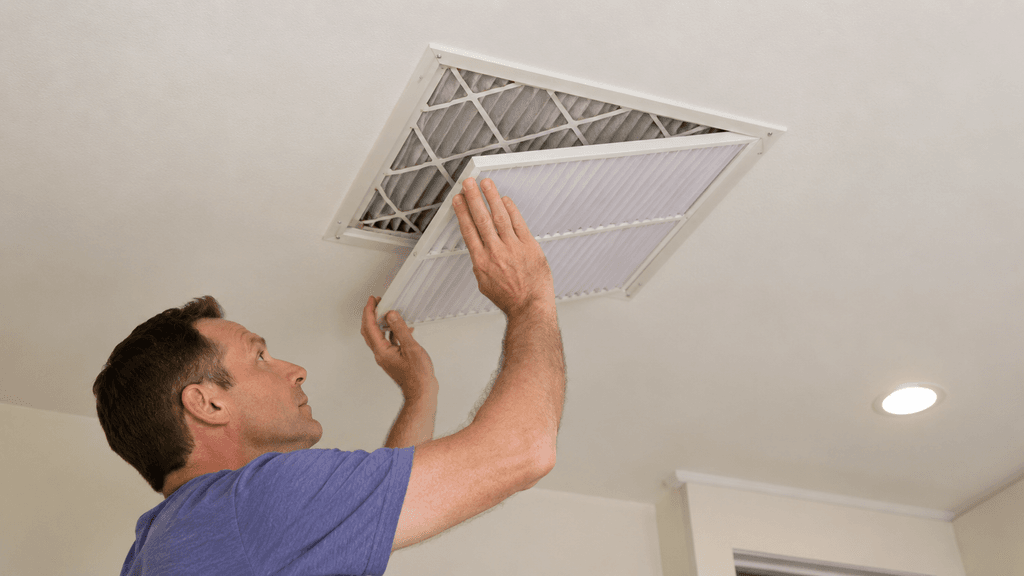
| Return-air grille | A large vent in a wall or ceiling, often hinged or held by clips. The filter sits right behind the grille. | Apartments, homes with the air handler in a closet or attic |
| Filter slot at the furnace or air handler | A narrow slot or cover on the side of the unit or on the return duct next to it. | Basements, garages, utility closets |
| Media cabinet | A separate metal box on the return duct, 4–6 inches deep, with a removable door. | Systems that use 4- to 5-inch media filters |
Some homes have a filter at every return grille. If you find more than one, check them all and log each one separately. Never remove panels held by screws to look for a filter. If you cannot find it, the equipment manual or a technician can show you.
How to buy the right size and MERV rating
Nominal size vs. actual size
The size printed on a filter is the nominal size, a rounded number. The real dimensions are slightly smaller. For example, a filter sold as 16 × 25 × 1 actually measures about 15.75 × 24.75 × 0.75 inches, according to AirFilters.com. Exact dimensions vary by brand.
- Buy by the nominal size printed on the old filter’s frame: width × height × depth.
- No old filter or no label? Measure the slot and round up to the nearest inch to get the nominal size.
- Take a photo of the label before you throw the old filter away, so you have it for next time.
Which MERV rating to choose
MERV measures how well a filter captures particles. It does not tell you how long the filter lasts. The EPA recommends a filter rated at least MERV 13, or as high as your system can accommodate. It also advises asking an HVAC technician if you are unsure what your system can handle.
The filter should fit snugly so air cannot leak around the edges, without bending or crushing it. Install it with the airflow arrow pointing toward the furnace or air handler, away from the return grille.
What filters cost per year
Annual cost = price per filter × changes per year. Check the current price of your size, then compare the two most common setups:
| Setup | Filters per year | Annual cost |
|---|---|---|
| 1-inch pleated, changed every 2 months | 6 | 6 × price of one filter |
| 1-inch pleated, changed every 3 months | 4 | 4 × price of one filter |
| 4- to 5-inch media, changed every 6–12 months | 1–2 | 1–2 × price of one filter |
Deep media filters cost more per unit, but you buy fewer of them. You can only use one if your system has a media cabinet or a slot deep enough for it.
Find your own interval: the 3-month filter log
The published ranges are a starting point. To learn what your home needs, check the filter on the same day each month for three months and fill in a log like this one:
| Date | Filter size and MERV | Condition (clean / light dust / coated / clogged) | Replaced? | Notes (pets, smoke, renovation, heavy use) |
|---|---|---|---|---|
If the filter is coated or clogged by the time you check it, shorten the interval by a month. If it still looks clean at the maximum interval its manufacturer allows, stay with that maximum. Do not stretch it further. Once you know your number, put a recurring reminder in your phone or your home maintenance binder.
Common questions
Is it bad to change the filter too often?
It does not harm the system, but it wastes money and filters. Replacing based on the monthly check, rather than a fixed date, avoids both problems.
I just moved in. Should I replace the filter right away?
Yes, unless you know when it was last changed. A new filter gives you a known start date for your log. It is one of the first tasks in our first-year home maintenance checklist.
Can I vacuum or wash a disposable filter?
No. Washing or vacuuming can damage the filter material and leave it less effective. Only filters labeled washable or reusable should be cleaned, following their instructions.
Related guides: Monthly home maintenance checklist · Annual home maintenance calendar · Winter home maintenance checklist
Sources: ENERGY STAR maintenance checklist; EPA, Guide to Air Cleaners in the Home; Carrier; Filtrete FAQ; AprilAire FAQ; AirFilters.com.