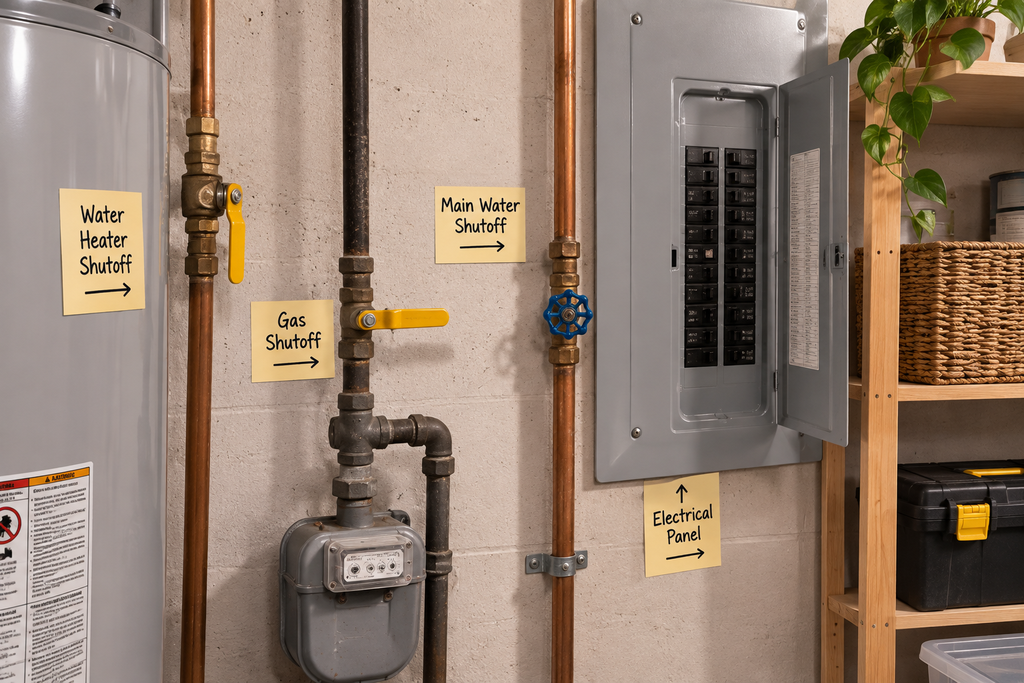
When a pipe bursts, there is no time to look for the main water valve. Your home has four emergency shutoffs worth knowing: the main water shutoff, the small valves under sinks and toilets, the electrical panel and, if you have gas, the gas meter valve. Finding and labeling all of them takes about 30 minutes, and the best time to do it is now, when nothing is wrong.
Three safety rules before you start
- If you smell gas (a rotten-egg smell) or hear hissing, do not look for the meter. Leave on foot, then call 911 and your gas company from outside.
- Never touch an electrical panel that is wet, buzzing, hot or damaged, or while you are standing in water. Call an electrician.
- Never force a valve that is stuck or corroded. It can break and cause the leak you are trying to prevent. Ask a plumber to check it.
Your home’s emergency shutoffs at a glance
| Shutoff | What it stops | Where to look first | Can you use it yourself? |
|---|---|---|---|
| Main water shutoff | Water to the whole house | Where the water line enters: basement or crawl space wall facing the street, garage, utility room, near the water heater; in warm climates, outside near a hose faucet | Yes, if it turns easily |
| Fixture valves | Water to one sink, toilet or appliance | Under sinks, behind toilets, behind the washer and fridge | Yes |
| Electrical panel | Power to one circuit or the whole house | Garage, basement, utility room, hallway or closet | Yes, for switching breakers; never open the inner cover |
| Gas meter valve | Gas to the whole house | On the pipe going into the gas meter, usually outside, 6–8 inches above the ground | Only in a real emergency, and the gas company must turn it back on |
1. The main water shutoff
This is the most useful emergency shutoff to find first, because water leaks are the most common home emergency. Follow the water line from where it enters the house. In homes with a basement or crawl space, the valve is usually on the wall that faces the street. In warmer climates, it is often outside, next to an outdoor faucet, according to 2-10 Home Buyers Warranty. Homes on a well usually have it near the pressure tank.
Can’t find it? Check your home inspection report, which normally notes its location, or ask your water utility.
Ball valve or gate valve: how to tell if it is open
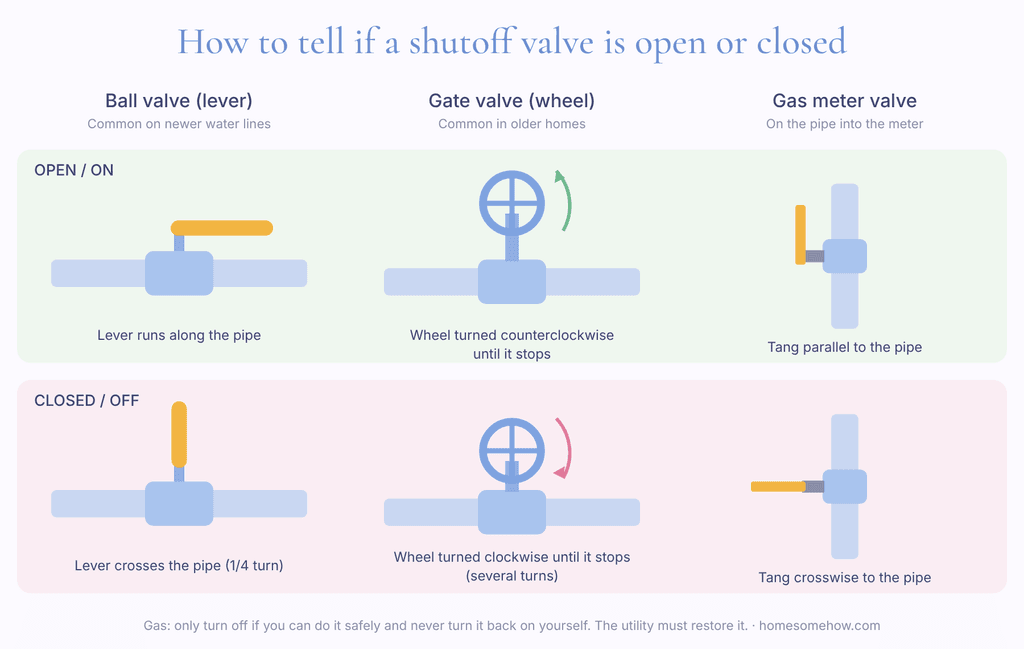
A lever along the pipe means open; across the pipe means closed.
- Ball valve (lever): common on newer plumbing. A quarter turn closes it. When the lever runs along the pipe, water flows; when it crosses the pipe, it is closed.
- Gate valve (round wheel): common in older homes. Turn it clockwise until it stops to close it; it usually takes several turns. Turn it counterclockwise to open it again.
The valve at the street is not yours
Many homes also have a valve in a box near the curb, marked “Water”. It usually belongs to the water utility and may need a special key. Use the valve inside or next to your house; if you do not have one, ask a plumber about installing one.
2. Fixture shutoff valves
These small valves stop the water to a single fixture, so you can deal with a leaking toilet without cutting water to the whole house.
- Sinks: two valves under the basin, one for hot and one for cold.
- Toilet: one valve on the wall or floor behind it, on the left side in most homes.
- Washing machine: two valves in a wall box behind the machine.
- Dishwasher and fridge ice maker: usually under the kitchen sink. Do not pull a heavy appliance out just to look; check under the sink first.
- Water heater: a valve on the cold-water pipe at the top of the tank.
Turn each one gently to make sure it moves and does not drip, then turn it back. If one is stuck or leaks around the handle, add it to your plumber list.
3. The electrical panel
The Electrical Safety Foundation International notes that the service panel is usually in the basement, garage or a utility area. Open only the outer door. Inside you will see a large main breaker, usually at the top, which cuts power to the whole house, and rows of smaller breakers, one per circuit. In some homes the main disconnect is in a separate box outside, next to the electric meter.
Fix the circuit labels
Most panel directories are vague or out of date. Replace general labels with specific ones:
| Vague label | Useful label |
|---|---|
| Kitchen | Kitchen outlets, counter left of sink |
| Plugs | Living room outlets and TV wall |
| Bedroom | Main bedroom lights and outlets |
| (blank) | Dishwasher |
To find out what each breaker controls, you need two people: one switches a breaker off while the other checks which lights and outlets go dead. Only label what you have confirmed. If a breaker keeps tripping, do not keep resetting it; call an electrician.
Keep the space in front of it clear
The National Electrical Code requires a clear working space in front of a home panel of at least 3 feet deep, 30 inches wide and 6.5 feet high, and says that space must not be used for storage (NEC 110.26). In practice: no shelves, boxes or holiday decorations in front of the panel.
4. The gas meter valve
If your home has natural gas, find the meter, usually outside. The shutoff valve is on the pipe that runs into the meter, about 6–8 inches above the ground. SDG&E explains how to read it: when the rectangular tab (the “tang”) is parallel to the pipe, the gas is on; when it is crosswise, the gas is off. Closing it takes a quarter turn with a 12-inch or larger adjustable wrench, which the utility suggests keeping with your emergency supplies.
Two things matter more than the valve itself:
- Do not practice shutting it off. Once the gas is off, you cannot turn it back on yourself: the gas company has to restore the service and relight the pilot lights, as SDG&E states.
- If you smell gas, leave first. The U.S. Pipeline and Hazardous Materials Safety Administration advises leaving the area on foot immediately, not trying to find the source, and calling 911 from a safe place. Do not use light switches, phones or anything that could make a spark near the leak.
If your home uses propane, the shutoff is on the tank. Ask your propane supplier for their instructions and emergency number.
How to label your emergency shutoffs
A good label answers one question: what does this control? Keep it short and specific.
- Use words, not codes: “MAIN WATER – WHOLE HOUSE”, not “Valve A”.
- Name the exact fixture: “UPSTAIRS BATHROOM – TOILET”, “KITCHEN SINK – HOT”.
- Use durable tags where it is damp, such as a basement or outside: a laminated tag on a zip tie or a waterproof label-maker label. Paper sticky notes fall off within weeks.
- Do not cover meter readings, warnings or the panel’s ratings, and do not hang anything from a valve handle.
- Bright colors help you spot a tag, but always write the words too, for people who see colors differently or in poor light.
Make a one-page card of your emergency shutoffs
Labels help whoever is standing next to the valve. A card helps someone who has never been in your basement, like a house sitter or a neighbor with your spare key. Copy this table into a document, fill it in and keep one printed copy on the inside of a kitchen cabinet door and a photo of it on your phone.
| Shutoff | Exact location | Type / how to close | Emergency number |
|---|---|---|---|
| Main water | e.g. Basement, front wall, behind the water heater | e.g. Lever, quarter turn | Plumber: |
| Electrical panel | e.g. Garage, left wall | Main breaker at the top | Electrician: |
| Gas meter | e.g. Outside, east side of the house | Leave and call; wrench in garage | Gas company: |
| Water heater |
Then show every adult in the house where each shutoff is. Walking the route once is worth more than any card. This is also one of the first tasks on our 30-day new home checklist, and the card fits well in a home maintenance binder.
If you rent
Ask your landlord or property manager which emergency shutoffs you are allowed to use and where they are. In apartment buildings the main water and gas controls are often shared and off-limits to tenants, but the fixture valves in your unit and your breaker panel are usually yours to use. Save the emergency maintenance number in your phone. See also our apartment maintenance checklist for renters.
Common questions
Should I test my main water shutoff?
Yes, gently, if it looks in good condition: close it, check that a faucet stops running, then open it again. If it is stiff, corroded or starts to drip, stop and call a plumber rather than forcing it. A valve that will not close is something you want to know about before an emergency.
What should I do first if a pipe bursts?
Close the main water shutoff. If water is near outlets, appliances or the electrical panel, do not walk through it or touch anything electrical; leave the area and call an electrician or 911.
Can I turn the gas back on myself?
No. Once the gas is shut off at the meter, the gas company must turn it back on and relight your appliances’ pilot lights.
How often should I check my emergency shutoffs?
Once a year is enough for most homes, and again after any plumbing, electrical or renovation work. Check that the labels are still readable, nothing is blocking the access and the card is up to date.
Related guides: Essential tool kit for first-time homeowners · How to prepare your home for freezing temperatures
Sources: SDG&E, Emergency gas shut-off; PHMSA, Pipeline leak recognition; ESFI, Understanding your home electrical system; NEC 110.26 working space summary; 2-10 Home Buyers Warranty. Always follow your utility’s instructions for your address.