A toilet that keeps running, refills on its own in the middle of the night or only stops when you jiggle the handle is one of the most common problems in any home. It is also one of the easiest to fix yourself. In most cases the cause is one of four parts inside the tank, the replacement part costs little at any hardware store, and the repair takes 10 to 30 minutes with no special tools.
It is worth fixing quickly. Denver Water estimates that an average leaking toilet can waste about 200 gallons of water a day, and the EPA’s WaterSense program notes that a worn flapper can silently leak thousands of gallons a year. This guide shows you how to fix a running toilet in three stages: understand the parts, find the cause, and fix it.
How a toilet tank works
Lift the tank lid and you will see four parts that matter. When you press the handle, the chain lifts the flapper at the bottom of the tank and the water rushes into the bowl. The flapper drops back and seals the drain. Then the fill valve refills the tank until the float rises high enough to shut it off. The tall overflow tube in the middle is a safety outlet: if the water ever gets too high, it spills into the tube instead of over the rim.
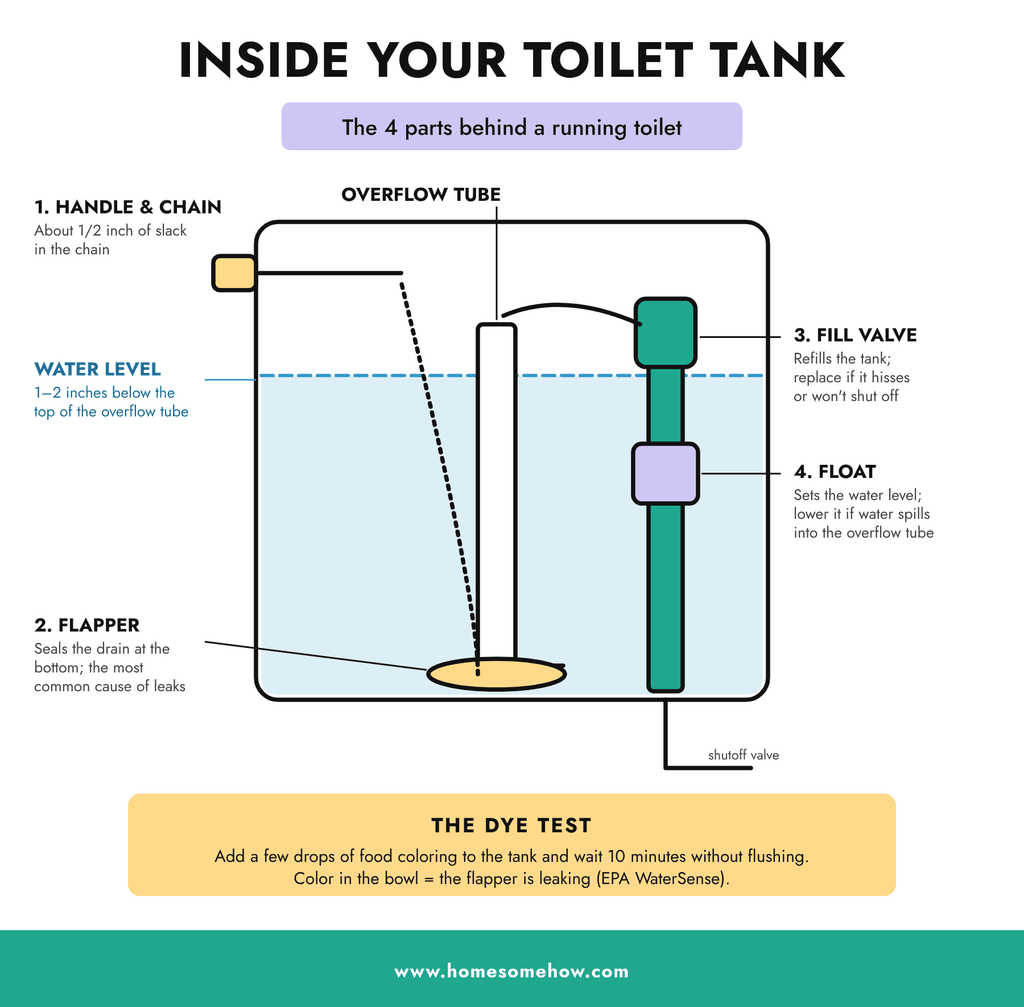
A toilet runs when one of these steps fails: water escapes past the flapper, or the fill valve never gets the signal to stop.
Find the cause in 2 minutes
Take the lid off and set it on a towel on the floor, because it is heavy and breaks easily. Then look at what the water is doing:
| What you notice | Most likely cause | Fix |
|---|---|---|
| Water keeps pouring into the top of the overflow tube | Water level set too high | Fix 1: lower the float |
| The toilet refills by itself every few minutes or hours, even when nobody uses it | Worn or dirty flapper leaking into the bowl | Fix 3: clean or replace the flapper |
| It runs after flushing until you jiggle the handle | Chain too short, too long or tangled | Fix 2: adjust the chain |
| The fill valve hisses or never fully shuts off, even with the float pushed up | Worn fill valve | Fix 4: replace the fill valve |
| Water runs into the bowl and the flapper looks fine | Worn flush valve seat or cracked overflow tube | Call a plumber (see below) |
The dye test
If you are not sure whether the flapper is leaking, use the test the EPA recommends: add a few drops of food coloring to the tank water (not the bowl) and wait 10 minutes without flushing. If color appears in the bowl, water is leaking past the flapper. Flush afterwards so the dye does not stain.
What you need
- Rubber gloves and an old towel
- A sponge and a small bucket, to empty the last water from the tank
- An adjustable wrench, only if you replace the fill valve
- Food coloring for the dye test
- The replacement part, if you need one: take the old part or a photo of it to the store
For fixes 3 and 4, start by turning off the water. The shutoff valve is on the wall or floor behind the toilet, usually on the left; turn it clockwise until it stops. Then flush to empty the tank. If you have never located your shutoffs, see our guide on how to find and label your emergency shutoffs.
Fix 1: Lower the water level
If water is spilling into the overflow tube, the float is set too high. Home Depot’s guide recommends a water level 1 to 2 inches below the top of the overflow tube. Many tanks also have a fill line marked on the inside wall or on the overflow tube; if yours does, use it.
- Cup float (a small cylinder that slides up and down the fill valve): turn the adjustment screw on top of the valve, or squeeze the metal clip on the side and slide the float down a little.
- Ball float (a ball on the end of a long arm, common in older toilets): turn the screw where the arm meets the valve, or gently bend the arm downward so the ball sits lower.
Flush and watch the tank refill. Adjust a little at a time until the water stops at the right level.
Fix 2: Adjust the chain
The chain connects the handle lever to the flapper. If it is too tight, it holds the flapper slightly open. If it is too loose, it can get caught under the flapper. Home Depot recommends that it hang straight with about half an inch of slack when the flapper is closed. Move the clip to a different link until it is right, cut off any long extra chain that could get trapped, and flush a few times to check that the flapper drops and seals every time.
Fix 3: Clean or replace the flapper
The flapper is a rubber seal that sits in water all day, so over time it warps, hardens or collects mineral buildup and stops sealing. The EPA recommends checking it periodically and replacing it at least every five years.
- Turn off the water and flush to empty the tank.
- Look at the flapper and the drain opening it sits on. If the flapper is soft and smooth, try cleaning first: wipe the flapper and the rim of the drain with a sponge to remove slime and mineral deposits.
- If it is stiff, cracked, warped or slimy even after cleaning, replace it. Unhook the chain from the handle lever, then slide or pop the flapper’s ears off the pegs on each side of the overflow tube.
- Buy the right size. Most toilets use a 2-inch or a 3-inch flapper. Fluidmaster explains how to tell: measure the old flapper across. If it is about 3 inches wide, you need a 2-inch flapper; if it is about 4 inches wide, you need a 3-inch flapper. Taking the old one to the store is the easiest way to get it right.
- Fit the new flapper on the pegs, clip the chain to the handle lever with about half an inch of slack, and turn the water back on.
- Repeat the dye test after the tank refills. No color in the bowl means the leak is fixed.
Fix 4: Replace the fill valve
If the fill valve keeps hissing or will not shut off even when you lift the float by hand, it is worn out. Replacement fill valves are universal for most toilets and come with instructions.
- Turn off the water, flush and sponge out the last water from the bottom of the tank into a bucket.
- Disconnect the supply line under the tank, with a towel underneath to catch drips.
- Unscrew the large nut under the tank that holds the fill valve, and lift the old valve out.
- Fit the new valve, adjusting its height to your tank as the instructions explain, and tighten the nut by hand plus a small turn with the wrench. Overtightening can crack the porcelain.
- Attach the refill tube to the overflow tube with its clip, so it sits above the opening rather than pushed down inside it.
- Reconnect the supply line, turn the water on slowly, check for drips under the tank and set the water level as in Fix 1.
When to call a plumber
- The drain opening under the flapper is chipped, rough or corroded, so even a new flapper cannot seal. Replacing the whole flush valve means taking the tank off the toilet.
- The overflow tube is cracked. It is part of the flush valve and needs the same repair.
- Water is leaking onto the floor, from under the tank or around the base of the toilet.
- The shutoff valve behind the toilet will not turn or leaks when you turn it.
- The tank or bowl is cracked.
How to keep it from happening again
- Do the dye test once a year, for example as part of your monthly home maintenance checklist.
- Replace the flapper every five years, as the EPA recommends, even if it still seems to work.
- Avoid drop-in tablet cleaners in the tank. Kohler, for example, warns in its homeowner’s guide that in-tank cleaners with chlorine can seriously damage the parts inside the tank and that using them voids the warranty. Clean the bowl with a regular toilet cleaner instead.
- Listen at night. A short refill when nobody has flushed is the first sign of a leaking flapper.
Frequently asked questions
Why does my toilet run every few minutes on its own?
Water is slowly leaking from the tank into the bowl, usually past a worn flapper. When the level drops far enough, the fill valve turns on to top it up. The dye test confirms it, and replacing the flapper usually fixes it.
Can a running toilet raise my water bill?
Yes. Denver Water estimates that a leak of 200 gallons a day costs its customers about $270 to $470 a year in wasted water, depending on where they live. Your own cost depends on your local water rates.
Is it safe to fix a running toilet myself?
Yes. Adjusting the float or chain and replacing the flapper or fill valve are simple repairs with no electrical risk. The water in the tank is clean supply water, not waste water. Call a plumber if water is leaking onto the floor, the shutoff valve will not turn, or the porcelain is cracked.
How long does it take to fix a running toilet?
Adjusting the chain or float takes about 5 minutes. Replacing a flapper takes 10 to 15 minutes, and a fill valve 20 to 30 minutes.