Moving into your first home does not mean you need a workshop. In the first weeks, almost everything you will do (assembling furniture, hanging pictures, putting up curtains, tightening a loose handle) needs the same ten basic tools. The big 100-piece kits look complete, but most of their pieces never leave the case.
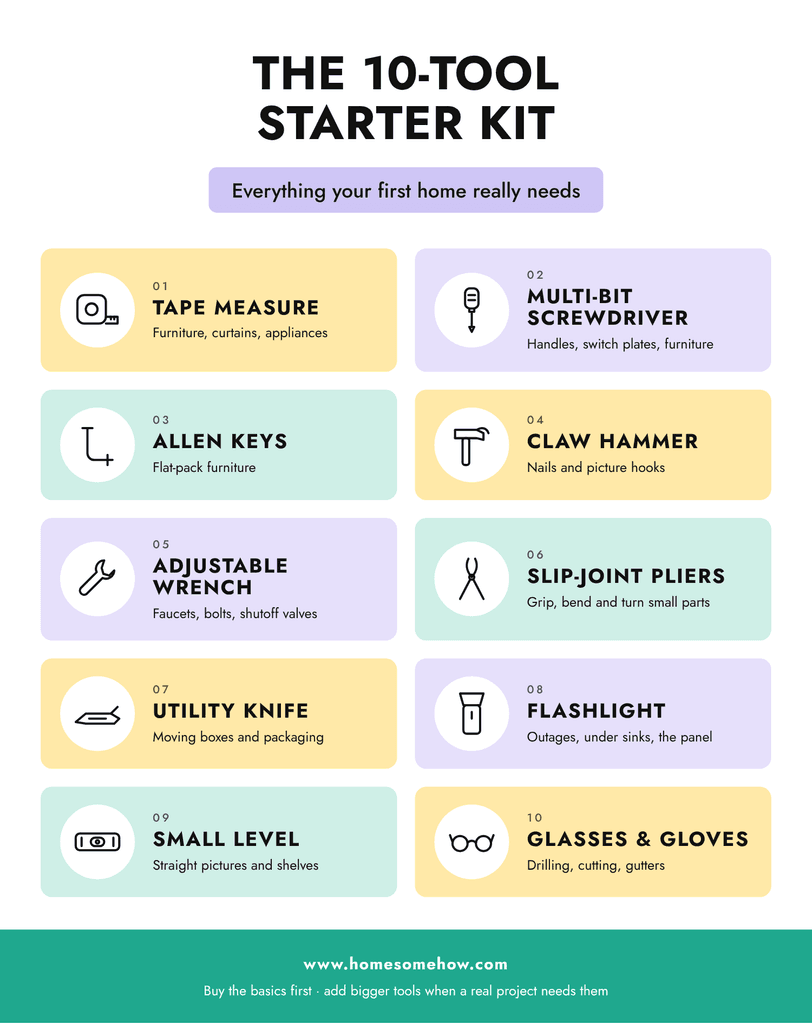
This essential tool kit for first-time homeowners covers what to buy first, what to wait for, and the small supplies that make the tools useful.
The essential tool kit: 10 tools to buy first
| Tool | What you will use it for | What to look for |
|---|---|---|
| Tape measure | Furniture, curtains, appliances, room sizes | 16 or 25 ft, with a lock that holds |
| Multi-bit screwdriver | Furniture, handles, switch plates | Includes a #2 Phillips and flat bits that click in firmly |
| Allen keys (hex keys) | Flat-pack furniture | A small set in inches and millimeters |
| Claw hammer | Nails, picture hooks | About 16 oz, comfortable grip |
| Adjustable wrench | Nuts, bolts, faucet connections, shutoff valves | 8 in, jaw that adjusts smoothly |
| Slip-joint pliers | Gripping, bending, turning small parts | Jaws that close evenly |
| Utility knife | Boxes, packaging, plastic | Blade that locks and retracts fully |
| Flashlight or headlamp | Power outages, under the sink, the electrical panel | Simple model and spare batteries |
| Small level | Pictures, shelves, curtain rods | Torpedo level, 9 in |
| Safety glasses and work gloves | Drilling, cutting, cleaning gutters | Glasses with side protection |
You can buy them one by one for about the same price as a large kit, and each one will be better quality. If you prefer a kit, choose a small one and check that it includes most of this list.
How to spot a good tool in the store
You don’t need professional brands, but a cheap tool that slips or bends will damage screws and make simple jobs frustrating. Before you buy, hold it and check a few things:
- Screwdriver: the bits should click in and not wobble. A loose bit strips screw heads.
- Adjustable wrench and pliers: open and close them. The jaws should move smoothly and meet evenly, with no play from side to side.
- Tape measure: pull out a few feet and press the lock. It should hold without slipping back.
- Hammer: the head should feel solid on the handle, and the grip should not slide in your hand.
- Utility knife: the blade should lock in place and retract completely, and spare blades should be easy to find.
A mid-priced tool that passes these checks will last for years of household use.
Your first projects and the tools they need
These are the jobs that come up in almost every new home during the first month, and what each one takes from the kit.
| Project | Tools | Supplies |
|---|---|---|
| Assemble a bed, desk or shelves | Allen keys, screwdriver | The hardware in the box (count it before you start) |
| Hang pictures and mirrors | Tape measure, level, hammer | Picture hooks, wall anchors for heavier pieces |
| Put up curtain rods | Tape measure, level, screwdriver or drill | Wall anchors, painter’s tape to mark the holes |
| Tighten loose handles and hinges | Screwdriver | None |
| Replace a shower head | Adjustable wrench, a cloth to protect the finish | Plumber’s tape |
| Change a toilet flapper | Your hands; pliers for a stiff chain | A new flapper that fits your toilet |
| Childproof outlets and cabinets | Screwdriver | Outlet covers, cabinet latches |
| Unpack moving boxes | Utility knife | Trash bags for packaging |
If something in this table goes beyond your comfort level, it is fine to leave it for a handyman. The kit is there to make the small jobs easy, not to turn every job into a weekend project.
The tools that matter in an emergency
Two of these tools do more than small repairs. Ready.gov, the U.S. government’s emergency preparedness site, includes a flashlight and a wrench or pliers to turn off utilities in its basic emergency kit. If a pipe bursts or you smell gas, you need to know where the shutoffs are and have the right tool at hand. Our guide on how to find and label your home’s emergency shutoffs explains where to look; do it in your first week, not during the emergency.
Add a flange plunger for the toilet to this group. It is not a tool you want to buy in a hurry. For a toilet that keeps running, an adjustable wrench and a new flapper fix most cases; our guide on how to fix a running toilet shows how.
The small supplies that make tools useful
A hammer is useless if you have no nails. Keep a small box with:
- Assorted screws, nails and picture hooks.
- Wall anchors for drywall, so shelves and heavy frames do not pull out.
- Painter’s tape, to mark where holes go and protect walls.
- Spare batteries for the flashlight and smoke alarms.
- Felt pads for furniture legs.
- Plumber’s tape for shower heads and threaded connections.
- Zip ties and a pencil.
Add these only when a real project needs them
Wait to buy bigger tools until you have a specific job. By then you will know what your home needs.
| Tool | Buy it when… |
|---|---|
| Cordless drill/driver | You need to hang shelves, mount a TV or assemble a lot of furniture |
| Stud finder | You are hanging something heavy on drywall |
| Caulk gun | The caulk around the tub or sink starts to crack |
| Step ladder | You can’t reach light fixtures, smoke alarms or high shelves safely |
| Hand drain snake | A sink or shower drains slowly and the plunger did not help |
Before drilling, check what is behind the wall: pipes and wires often run straight up and down from outlets and switches.
A smaller kit for renters and apartments
If you rent or live in a small apartment, you can start with even less: the screwdriver, Allen keys, tape measure, utility knife, flashlight and a small hammer cover most jobs. Your landlord is usually responsible for plumbing, electrical and appliance repairs, so you will rarely need the wrench for anything more than tightening a loose connection. Keep the kit in a shoebox-sized container on a closet shelf, and add removable hooks and strips to the supplies. Check your lease before drilling into walls: removable strips are often allowed when screws are not.
Keep everything in one place
At home we keep all our tools in one toolbox, and that is the most useful decision of all: whoever needs the screwdriver knows exactly where it is, and it goes back to the same place. Tools spread across kitchen drawers and closets are tools you end up buying twice.
Choose a box you can carry with one hand and store it somewhere easy to reach, like a hall closet or under the kitchen sink, not at the back of the garage. Keep the flashlight on top so you can find it in the dark. If you keep a home maintenance binder, store it next to the toolbox with the appliance manuals.
Know when to stop
Having tools does not make every job a DIY job. Electrical wiring, gas lines, the water heater and anything on the roof are for licensed professionals. A basic kit is for small fixes and assembly; for everything else, the most useful tool is a good plumber’s or electrician’s phone number.
Frequently asked questions
Should I buy a pre-made tool kit or individual tools?
Individual tools usually give you better quality for a similar price, because you pay only for what you use. A small pre-made kit is fine if it includes most of the ten basics and the pieces feel solid.
Do I need a drill right away?
Not necessarily. A screwdriver and Allen keys are enough for most flat-pack furniture. Buy a cordless drill when you need to hang shelves or mount something heavy.
What is the most important tool for a new homeowner?
A good multi-bit screwdriver, because you will use it almost every week. In an emergency, though, the flashlight and the adjustable wrench matter most: they let you see in a power outage and turn off a valve if there is a leak.