
The first month after moving into a new home can feel like one long moving day. There are boxes in every room, unfamiliar switches, documents to file, services to set up and a long list of things you would like to change. When everything feels urgent, it is easy to spend time and money on the wrong things.
Your first 30 days are not about finishing the house. They are about making it safe, getting daily life working, learning how the home behaves and deciding what really deserves your attention. This checklist is organized by time: a detailed plan for the first week, then one focus for each of the following three weeks.
The short answer: what to do first after moving into a new home. Secure the doors and change the codes, check that water, power and heating work, find the main water shutoff and the electrical panel, test the smoke and carbon monoxide alarms, and set up the bed, one bathroom and a basic kitchen. Everything else can be done gradually.
Your first month in a new home at a glance
| When | Focus | Main tasks |
|---|---|---|
| Days 1–7 | Safe and livable | Locks and codes, utilities, shutoffs, alarms, bed, bathroom, kitchen, address change |
| Week 2 | Learn how the house works | Reread the inspection report, use the appliances, observe the rooms |
| Week 3 | Organize information and everyday things | Home file, address updates, home inventory, a place for keys, mail and supplies |
| Week 4 | Decide what deserves time and money | Prioritized repair list, warranties, budget, next three priorities |
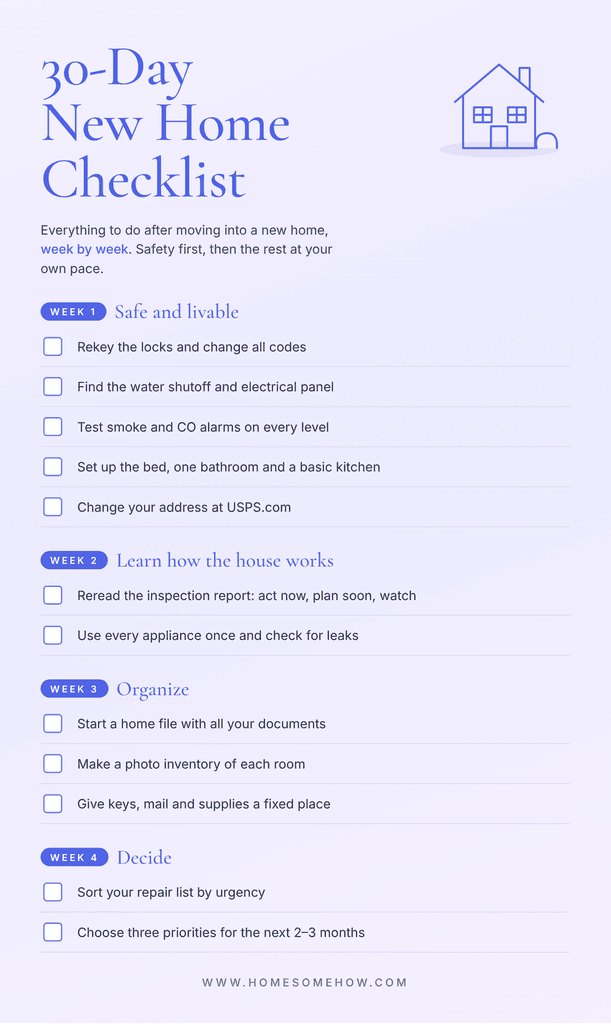
Week 1: Make the home safe and livable
Day 1: Secure the home
- Test every key, remote and code you received: doors, mailbox, garage, gate.
- Rekey or replace the exterior locks if you bought the home. You never know how many copies of the old keys exist. A locksmith can tell you whether rekeying is enough.
- Reset the garage and keypad codes and remove previous users from smart locks, cameras and alarm accounts, following each manufacturer’s transfer process.
- Walk around in daylight and check that doors and ground-floor windows close and latch. Look only for things that are unsafe tonight: broken glass, a loose step, a missing handrail.
Day 1: Check that the basics work
Turn on several lights, run hot and cold water, flush the toilets, check that the heating or cooling responds to the thermostat and that the fridge is cooling. Look for water on the floor, damp stains, a toilet that keeps running, burning smells or outlets that feel hot. If you smell gas or suspect an electrical danger, leave the house and call 911 and the utility from outside.
Days 1–2: Find the shutoffs and the electrical panel
You do not want to search for the main water valve while water is spreading across the floor. Find the main water shutoff, the electrical panel and, if you have gas, the gas meter, and keep the space in front of them free of boxes. Our guide on how to find and label your emergency shutoffs shows you how to recognize each one and how to tell if a valve is open or closed.
Days 1–2: Test the smoke and carbon monoxide alarms
An alarm on the ceiling is not proof that it works. Press the test button on every one. The U.S. Fire Administration recommends smoke alarms on every level, inside each bedroom and outside sleeping areas, and replacing the whole alarm every 10 years; check the manufacture date printed on the back. The Consumer Product Safety Commission recommends carbon monoxide alarms on every level and outside sleeping areas. If any are missing, add them to your shopping list for this week.
Days 1–3: Unpack for daily life, not for perfection
After moving several times, I have found it much easier to keep the essentials in a suitcase or a clearly marked bag instead of searching for the right box after a long day. I would rather know exactly where my medication, charger, clean clothes, toiletries and important documents are than open six boxes at midnight.
Then set up three spaces, in this order:
- The bedroom: bed assembled, clean sheets, a lamp, a clear path to the door and bathroom.
- One bathroom: fully stocked and working. One finished bathroom is more useful than three half-unpacked ones.
- A basic kitchen: enough plates, pans and food for simple meals, plus cleaning supplies. Check under the sink for leaks.
Days 2–4: Check the systems you depend on
Reset the thermostat schedule to your routine. Check the HVAC filter and note its size; if you do not know when it was last changed, replace it. See how often to change your HVAC filter. Run the dishwasher and washing machine once while you watch for leaks, and photograph the model labels of the main appliances.
Days 3–5: Handle the paperwork
- Change your address with the Postal Service at USPS.com or at a post office. The U.S. Postal Inspection Service explains that the official online change costs $1.10 for identity verification and warns about look-alike websites that charge up to $40, sometimes without completing the change.
- Check that utilities and internet are in your name and that your homeowners or renters insurance has the right address.
- Find out the trash and recycling days, mailbox access and any HOA rules.
- Keep closing documents and sensitive papers in one place, out of sight while movers or workers come and go.
Days 3–7: Try the layout before you fully unpack
It is tempting to unpack around the furniture wherever the movers left it. I prefer to live with a basic layout for a few days and change it early if something feels wrong: a sofa that blocks the path through the room, a bed in front of the only outlet, a desk with glare all afternoon. Moving a sofa is much easier before the shelves around it are full.
Days 4–7: Unpack one room at a time
- Finish the daily-use items in the bedroom, bathroom and kitchen first.
- Unpack what you need for work, school, children or pets this week.
- Stack boxes for other rooms in those rooms, without opening them all.
- Keep one corner for donations, returns and packing material.
- Flatten empty boxes and keep hallways and exits clear.
Do not buy storage containers yet. Wait until you know what needs storing and where.
Week 2: Learn how your new home works
Reread the inspection report
After a week of living in the home, the inspection report makes much more sense: you now know which door sticks and which shower drains slowly. Sort its notes into three groups:
- Act now: safety issues, active leaks, a lost essential service or damage that is getting worse.
- Plan soon: stable repairs that affect daily life.
- Watch: things that are stable now; photograph them and check again in a few months.
Use everything at least once
Run the oven, cooktop, dishwasher, washer and dryer and look for leaks, error codes or unusual noises. Stop using anything that smells burnt, trips a breaker or leaks, and call a professional.
Observe before you change
Notice the light in each room at different times of day, the noise, the temperature and where coats, bags, mail and shoes naturally pile up. If it rains, look from the ground at how the gutters and the yard drain. These observations tell you what the house needs better than any plan made in an empty room.
Week 3: Organize the information and the everyday things
- Start a home file: closing and inspection papers, insurance, manuals, warranties, utility accounts and receipts in one folder, physical or digital. Our guide to creating a home maintenance binder shows a simple setup.
- Finish the address changes: bank, employer, insurance, doctors, subscriptions. Driver’s license, vehicle registration and voter registration rules vary by state, so check your state’s official websites for deadlines.
- Make a quick home inventory: photograph each room and your most valuable things, for insurance. Store it securely.
- Give everyday things a place: one landing spot for keys, one inbox for mail, one shelf for cleaning supplies. See how to create organization zones.
Week 4: Decide what deserves time and money
- Make one repair list sorted by consequence: safety issues and active leaks first, then repairs that affect daily use, then upgrades and decoration in a separate list.
- Check warranties before booking work. For a new build, read the builder’s warranty and its reporting deadlines, and document defects with dated photos.
- Set a starting budget for maintenance and unexpected repairs, based on the age of the house and what the inspection found.
- Choose only three priorities for the next two or three months, for example one repair, one room to organize and one savings goal.
For everything that comes after the first month, follow our first-year home maintenance checklist.
What can wait until after the first month
Decorating every room, buying organizers for every cupboard, painting the whole house, buying furniture to fill empty corners, landscaping and organizing the garage or attic can all wait. Living in the home first often shows that a room needs a different use or that something you planned to replace works fine. The exception is anything unsafe or getting worse: a leaking pipe never waits.
End-of-month review
- ☐ Locks rekeyed and all codes changed
- ☐ Smoke and CO alarms tested on every level
- ☐ Main water shutoff, electrical panel and gas meter located
- ☐ Address changed with USPS and the main accounts
- ☐ Utilities and insurance in your name
- ☐ Bedroom, bathroom and kitchen fully working
- ☐ Home file and inventory started
- ☐ Repair list sorted, with three priorities chosen
If some boxes are still unticked, the month was not a failure. Move them into next month’s plan and start with the most important one.
Frequently asked questions
What should I do first after moving into a new home?
Secure the doors and change the codes, check that water, power and heating work, find the main water shutoff and the electrical panel, and test the smoke and carbon monoxide alarms. Then set up the bed, one bathroom and the kitchen.
What should I unpack first in a new home?
Whatever you need to sleep, wash, eat, take medication and get dressed. Keep those things in a separate bag on moving day so you do not have to search for them.
What if I can’t finish everything in 30 days?
That is normal. Safety items and active problems come first; everything else can move to the following month. The goal is a home that works, not a finished one.