When the same things keep landing on the same counter, chair or corner, the problem is rarely a lack of discipline. That spot is telling you that those things have no home close to where you use them. Organization zones fix exactly that: each activity gets one place, and putting things back becomes easier than leaving them out.
Clutter is more than an eyesore. In a four-year study of 32 dual-income families in Los Angeles, UCLA researchers found that managing the volume of possessions raised mothers’ stress hormone levels. You do not need fewer things to feel the difference; you need to know where each one goes.
What an organization zone is
An organization zone is a space for one activity and the things it needs. It can be as big as a laundry corner or as small as a tray. Keys near the door, coffee next to the coffee maker, chargers in one drawer: each of those is a zone. Its size also sets a limit. When the cable box is full, it is time to get rid of the cables you don’t use, not to buy a second box.
How to create organization zones in 5 steps
- Watch where things land for a few days. The spot where your bag, the mail or the chargers always end up is where the zone should be, even if it is not the “right” place on paper.
- Group things by activity. Everything you use to make coffee, everything you take when you leave the house, everything you need to pay bills. “Miscellaneous” is not an activity.
- Put the zone where the activity happens. If putting something away means crossing the house, it will stay on the nearest table.
- Give it a boundary. A tray, a basket, a drawer or half a shelf. Use an open container for things you grab several times a day; a lid adds one step too many.
- Test it for two weeks before buying anything. Use a shoebox, a bowl or a jar you already have. If after two weeks you still use it, then measure the space and buy something that fits.
Start with the entry: the zone that saves the most time
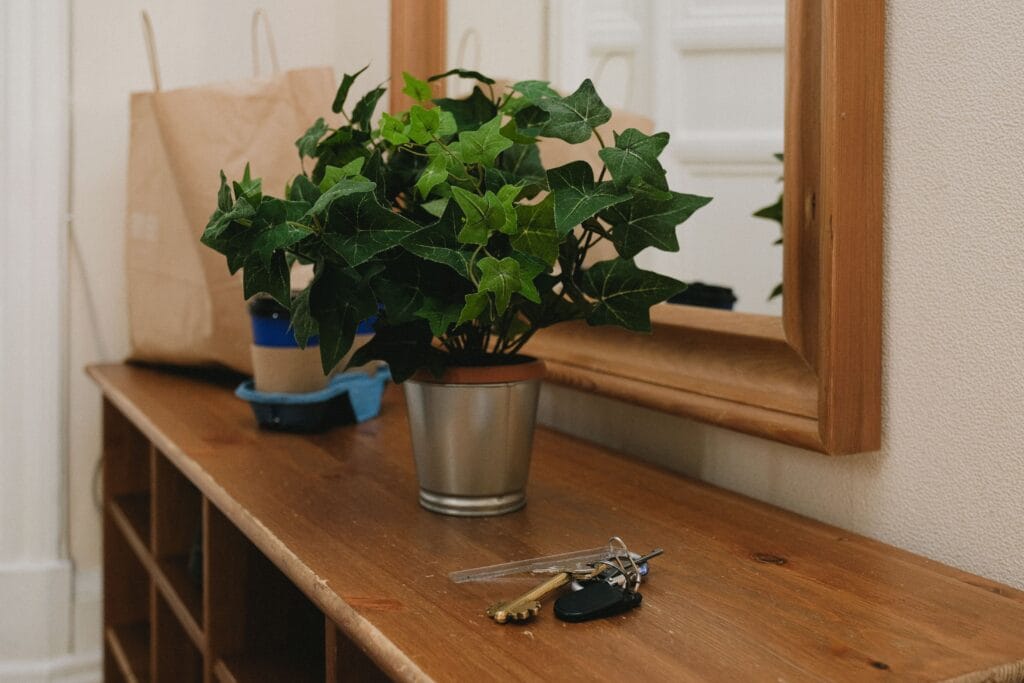
At home we leave the keys in a tray as soon as we come in. A tray works better than a hook for us because dropping the keys takes no effort at all, even with full hands, and it is always obvious where they are. The same tray catches sunglasses and the odd coin, and that is fine: a zone should match how you actually behave, not how you think you should.
A good entry zone needs only three things: a place for keys, a place for bags or coats, and a place for mail that needs action. With those three, most of the clutter that spreads into the rest of the house stops at the door.
Don’t buy organizers first
I have bought boxes and baskets that I ended up not using: they looked perfect in the store, but at home they did not fit the shelf or did not match how I used that space. It is one of the most common mistakes, because buying containers feels like organizing. The order is the opposite: decide the zone, test it with what you have, measure, and only then buy. Often you do not need to buy anything at all.
Organization zone ideas for every room
| Room | Zone | What goes there |
|---|---|---|
| Entry | Out-the-door zone | Keys tray, bags, mail to deal with, dog leash |
| Kitchen | Coffee or breakfast zone | Mugs, coffee, cereal and the tools you use every morning |
| Kitchen | Under-sink zone | Dish soap, sponges, trash bags, degreaser |
| Living room | Charging zone | Chargers, remotes, headphones |
| Bedroom | Getting-ready zone | Makeup, accessories, the things you use every morning |
| Bathroom | Daily zone | Toothbrush, skincare and what you use daily; spares go higher up |
| Laundry area | Clothes-care zone | Detergent, stain remover, clothespins, a basket for socks without a pair |
| Hall closet | Home repair zone | Batteries, light bulbs, flashlight, basic tools |
These are starting points. Create a zone only where something keeps piling up; a perfectly organized station that nobody uses is still wasted space. For the pantry, our guide to small pantry organization without expensive containers applies the same idea shelf by shelf.
Several zones in one room
A bedroom can hold sleep, work and getting ready at the same time if each has its own place. In my room, the desk is the work zone, and one corner is for makeup and getting ready. It works because the work things never go to the makeup corner and the other way around. If papers start appearing on the bed or makeup on the desk, the boundary is not clear enough or one of the zones is too small.
Zones for families with children
- Put children’s zones at their height: a low hook for the school bag, a basket for shoes, a shelf they can reach for toys.
- Use pictures instead of words on toy bins for children who cannot read yet.
- Keep medicines, cleaning products and sharp tools in a high or locked zone, even if it is less convenient.
Signs a zone is not working
- Things keep landing next to the zone instead of inside it: it is too far or too hard to open.
- It overflows: it is too small, or it holds things that do not belong to that activity.
- Nobody else in the house uses it: it only makes sense in your head. A label or a quick talk usually fixes it.
A daily five-minute pick-up keeps the zones working; our 15-minute nightly reset includes it.
Frequently asked questions
Where should I start creating organization zones?
At the entry or in the kitchen. They are the places where clutter piles up fastest, and a simple zone, like a tray for keys or a coffee corner, shows results the same day.
Do I need to buy containers to organize?
No. Start with boxes, jars or baskets you already have. Buy only after the zone has worked for a couple of weeks and you have measured the space.