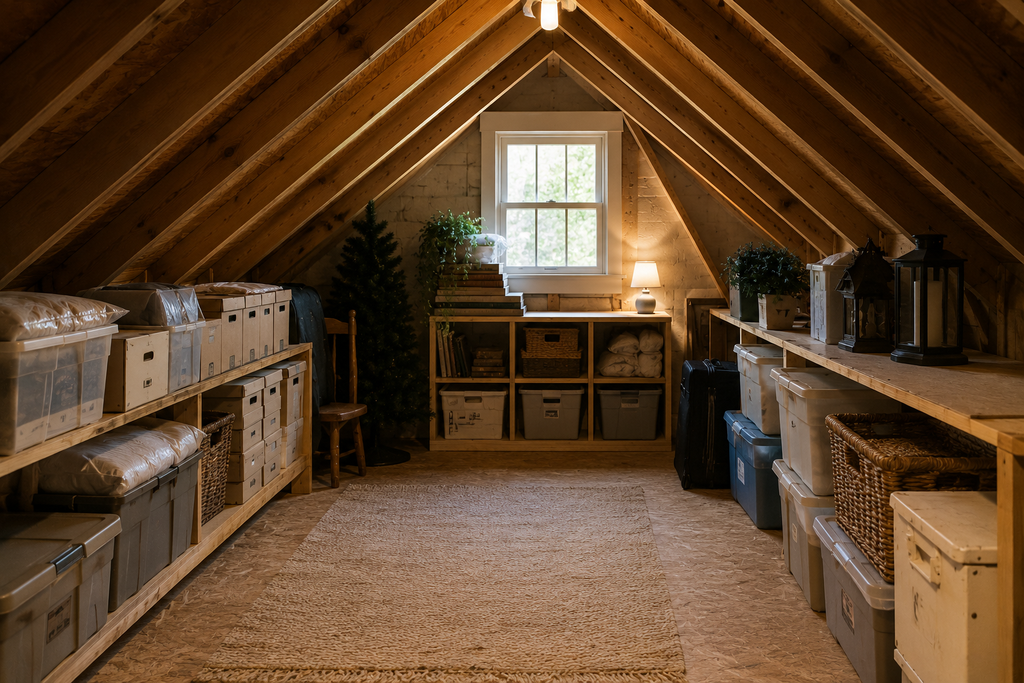
My family doesn’t have an attic, but we have something that behaves exactly like one: a small storage room. It holds the Christmas decorations, old costumes, a piece of furniture or two and all the things we don’t use often. And, like every small storage space, it slowly filled up with things nobody uses at all. The boxes we need once a year ended up behind the ones we never open, and getting the decorations out every December meant moving half the room.
A small attic has the same problem, plus a few of its own: low ceilings, heat, insulation and a ladder you have to climb with every box. This guide shows how to organize a small attic without wasting space, starting with what should never go up there and ending with a layout that lets you reach what you need without unpacking everything else.
First, check that your attic can be used for storage
Not every attic is a storage space. Some are finished rooms with a real floor; others are just the space between the ceiling and the roof. Before you carry anything up, look at four things:
- The floor. You need a solid floor of plywood or boards to walk and store on. If you only see wooden joists with insulation between them, don’t step between them: the ceiling below is just drywall and won’t hold you. Adding a floor and deciding how much weight it can carry is a job for a contractor.
- The insulation. If you see loose, pebble-like insulation that is gray-brown or silver-gold, it may be vermiculite. The EPA says to assume it contains asbestos, to leave it undisturbed and not store boxes or other items in the attic, and to hire a professional if it needs to be removed.
- The access. A pull-down ladder has a weight rating on its label. You plus a full box must stay under it. If climbing with a box feels unsteady, it is, and the attic is only for light things.
- Signs of trouble. Look for water stains on the wood, damp insulation, a musty smell, droppings or nests. Fix leaks and pest problems before anything goes up, because boxes hide them.
Also, never cover the vents along the roof edges and the roof, or block access to ducts, wiring, fans or anything a technician might need to reach. That space isn’t wasted; the attic needs it to breathe.
Don’t crush the insulation
Insulation keeps your house warm in winter and cool in summer, but only when it has its full thickness. The U.S. Department of Energy notes that insulation that is compressed will not provide its full rated R-value. Boxes stacked directly on insulation squash it, and you pay for it on your energy bill.
If your attic floor only covers part of the space, store things on that part. If you want more storage, ask a contractor about raised storage platforms that sit above the insulation instead of on it.
What can go in the attic, and what can’t
Most attics get very hot in summer and cold in winter, and humidity goes up and down with the weather. That rules out a lot of things. The National Archives, for example, recommends keeping family papers and photographs out of hot attics, below 75°F and below 65% relative humidity. An unfinished attic in July is far from that.
| Good for the attic | Keep somewhere else |
|---|---|
| Holiday decorations (except candles) | Photos, documents and keepsakes |
| Empty suitcases | Candles, crayons and anything made of wax |
| Costumes and seasonal clothes in sealed bins | Paint, aerosols, gasoline and anything flammable |
| Camping gear like tents and sleeping bags (fully dry) | Electronics and spare batteries |
| Kids’ clothes being saved for a younger sibling | Vinyl records, film and old videotapes |
| Sturdy furniture you are keeping for later | Leather, fur and fine wood furniture |
| Spare bedding in sealed bins | Food, pet food and wine |
A good rule: if heat would melt it, warp it, fade it or make it dangerous, or if you couldn’t replace it, it doesn’t go in the attic.
Declutter before you organize
This was the hardest part with our storage room, and it will be with your attic too. A small storage space fills up with “just in case”: the costume nobody fits into anymore, the chair that needs a repair nobody will do, the box of decorations we stopped putting out years ago. Every one of those takes the space of something you do use.
Bring everything down, or at least to one side, and sort it into four groups:
- Keep in the attic: things you use at least once a year that can handle the heat.
- Keep somewhere else: things that matter but can’t handle the attic, or that you use too often to climb for.
- Give away or sell: things that work but your family doesn’t use anymore. Costumes are great for schools, theater groups and friends with younger kids.
- Throw away or recycle: anything broken, moldy or missing pieces.
Sort by category, not box by box. If you find holiday decorations in five different boxes, put them all together first. Then keep only what you actually put out last year. You will probably need fewer bins than you have now.
Plan the layout around the hatch
In a small attic, everything depends on distance from the entrance. Think of it in three zones:
| Zone | Where | What goes there |
|---|---|---|
| Near | Within arm’s reach of the hatch | What you take down more than once a year: seasonal clothes, suitcases, the fall and Halloween box |
| Middle | Along the main path, where you can stand | Things you need once a year, like Christmas decorations and the tree |
| Far | Under the low eaves and in the back corners | Things you rarely need: baby clothes for later, spare furniture, camping gear |
Then keep a clear path from the hatch to the far end, at least wide enough to walk with a bin in your hands. It feels like wasted space, but without it you have to move everything to reach anything. That path is what made our storage room usable again.
Use the low space under the roof
The triangle where the roof meets the floor is the space most attics waste. Low, flat bins slide in there well, with one rule: only one row deep. If you put a second row behind the first, you will never see it again. Put the short side of each bin facing the path, with the label on it, so you can pull it out like a drawer.
Where you have full height, in the center of the attic, a simple freestanding shelf unit keeps bins off the floor and lets you reach the middle ones without unstacking. Don’t screw anything into the rafters without asking a professional first.
Choose the right containers
- Clear plastic bins with lids, not cardboard. Cardboard absorbs moisture, crushes when stacked and attracts insects and mice. Clear bins let you see what’s inside.
- Measure the hatch first. The bin has to fit through the opening, carried at an angle, while you are on a ladder.
- Medium size, not large. A big bin full of decorations can be too heavy to carry down a ladder safely. If you can’t carry it with one hand while holding the ladder with the other, it’s too big for the attic.
- The same two or three sizes. Matching bins stack steadily and fit the shelves. Random boxes waste space between them.
- Labels on two sides. One on the end that faces the path and one on the lid, written big enough to read with a flashlight.
How to store the awkward things
- Christmas tree: in its own long storage bag, lying flat in the middle zone.
- String lights: wrapped around a piece of cardboard or an empty paper towel tube so they don’t tangle, then in a labeled bin.
- Ornaments: in a bin with dividers or wrapped in tissue paper. Put fragile ones on top, not at the bottom.
- Wreaths: hung on a hook or in a round wreath box, so they don’t get crushed.
- Costumes: folded in a bin, one bin per person or per size, with the accessories in a zip bag inside.
- Furniture: remove legs if you can, and keep the screws taped to the piece. Cover it with an old sheet, not plastic, so moisture doesn’t get trapped. Keep it on the floored area, never on joists.
- Suitcases: store small ones inside big ones, and use them to hold soft things like spare pillows.
If you are planning this year’s holiday decorations, our guides to simple fall decorating and simple Christmas decorating help you keep fewer decorations, and fewer boxes to store.
Keep a list of what is up there
The best way to avoid climbing up to look for something that isn’t there is a simple inventory. Number each bin, take a photo of what’s inside before you close it, and keep a note on your phone: “Bin 4: Christmas lights and extension cords”. It takes ten minutes and saves you from opening six boxes in the heat. You can also keep it in your home maintenance binder.
A quick check twice a year
The best moments to check the attic are when you’re already going up: when the holiday decorations come down in late fall and when they go back up in January. While you’re there:
- Look at the roof boards and around the chimney and vents for water stains.
- Check for droppings, nests or chewed boxes.
- Make sure no bin has ended up in the path or against a vent.
- Take out one thing nobody has used in two years.
These two checks also fit well into our annual home maintenance calendar.
Common small attic mistakes
- Filling the attic before checking it. Boxes hide leaks, pests and unsafe insulation.
- Stacking boxes on the insulation. You lose storage and energy efficiency at the same time.
- Using it for things that can’t handle heat. Photos, candles and electronics are the classic losses.
- No path. If you have to move three boxes to reach one, the attic is full, even if there’s space left.
- Keeping “just in case” forever. If you didn’t miss it in two years, someone else can probably use it.
- Carrying heavy boxes on the ladder. Lighter bins and two trips are always safer than one heavy trip.