
A small pantry does not work because every ingredient has been poured into a matching jar. It works when you can see what you have, find what you need and put the shopping away without rearranging half the shelves. The rule that makes small pantry organization work is simple: categories first, containers second. Group the food the way you cook and shop, give each group a shelf, and only then decide whether anything needs a container. Usually the answer is a box you already have.
In my own pantry I keep it simple: pasta with pasta, spices together in one box, and lentils, chickpeas and beans side by side. Nothing matches, and I can still find everything in seconds.
Small pantry organization in 5 steps
1. Empty one shelf at a time
Do not empty the whole pantry onto the floor. Take out one shelf, wipe it, and put the food on the counter. Take a photo before you start, so you can compare later.
2. Sort into four piles
- Keep: food your household eats.
- Use soon: open duplicates and anything near its date.
- Move: bulk backstock, pet food, paper goods and anything that is not food.
- Throw out: spoiled food and damaged cans. The USDA Food Safety and Inspection Service says to discard cans that are bulging, leaking, heavily rusted or have a dent deep enough to fit your finger in.
Not sure how long something lasts? Check it in the free FoodKeeper app, made by the USDA with Cornell University. As a rule of thumb from the same USDA page, high-acid cans such as tomatoes keep 12–18 months and low-acid cans such as vegetables 2–5 years.
3. Group the food into categories
Use only the categories your household needs. Most small pantries work with five or six:
| Category | What goes in it | Tip |
|---|---|---|
| Pasta and grains | Pasta, rice, couscous, oats | Open packages at the front |
| Legumes and cans | Lentils, chickpeas, beans, canned tomatoes, tuna | Labels facing out, same item in one row |
| Breakfast and snacks | Cereal, crackers, bars, nuts | Easiest shelf in the pantry |
| Baking | Flour, sugar, baking powder, cocoa | Small packets in a box so they don’t get lost |
| Oils, sauces and spices | Oil, vinegar, sauces, spice jars | Oils on a tray; spices in one box |
| Backstock | Unopened spares | Keep them together and check before shopping |
Some foods fit two categories. Canned beans could go with cans or with legumes. Choose where you would look first and keep it there.
4. Give each shelf a job
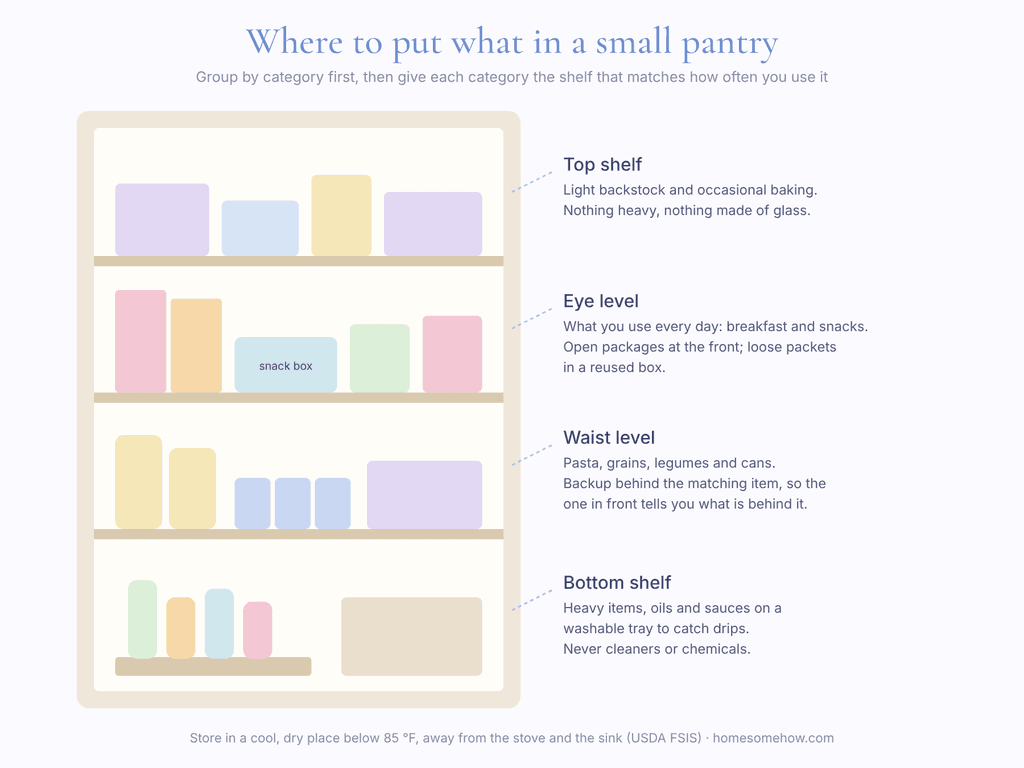
What you use most goes where you reach most easily.
- Top shelf: light backstock and occasional baking. Nothing heavy and no glass above head height.
- Eye level: what you use every day, usually breakfast and snacks.
- Waist level: pasta, grains, legumes and cans.
- Bottom shelf: heavy items, plus oils and sauces on a tray that catches drips.
Keep cleaners and chemicals out of the pantry entirely. If you have small children, put snacks they are allowed to take on a low shelf and everything else higher up.
5. Use what you already own
Before buying anything, look around the house. These everyday items do the same job as most pantry organizers, for free:
| Problem | Free solution | How to use it |
|---|---|---|
| Small packets fall behind everything | Shoebox or sturdy delivery box | Cut the front lower so you can see inside; one box per type (sauces, yeast, seasoning mixes) |
| Bags of rice or pasta tip over | Cereal box cut diagonally | Makes a “magazine file” that holds bags upright |
| Open bags go stale | Glass jars from sauce, jam or pickles | Wash and dry well; use only jars that close tightly |
| Oil bottles leave rings on the shelf | Old baking tray or a plate | Put all the bottles on it; wash the tray, not the shelf |
| Things at the back are forgotten | Shallow box used as a drawer | Put light items in it and pull the whole box out |
| Bags won’t stay closed | Binder clips or clothes pegs | Fold the bag twice and clip it |
Replace any cardboard box that gets damp or stained. When you move food into a jar, keep the label information you need, such as cooking time, allergens and date. Cutting it out and taping it to the jar takes ten seconds.
When it is worth buying an organizer
Most small pantry organization problems can be solved with the free ideas above. Buy something only when you can name the problem it solves. “The pantry looks messy” is not enough. “Cans at the back are hidden and I keep buying tomatoes twice” is. Then buy the smallest thing that fixes it:
- Cans hide each other: a step riser, so the back row sits higher.
- Bottles get lost in a corner: a turntable (lazy Susan).
- A tall shelf has wasted space above the food: a freestanding shelf insert.
Measure the shelf width, depth and height after you have sorted your categories, not before. Containers bought first rarely fit the real packages.
Deep, narrow or shallow pantries
- Deep shelves: store the same product front to back, for example backup pasta behind open pasta. The item in front tells you what is behind it. A box used as a drawer stops the back from becoming a black hole.
- Narrow cabinet: one or two categories per shelf. Adjust the shelf heights if you can instead of stacking.
- Shallow shelves: you already see everything; just use a box for small packets.
How to keep a small pantry organized
- Put the shopping away by category, new items behind the older ones, so the older ones get used first.
- One open, one spare for the staples you use most. More than that usually ends up forgotten.
- Leave a little empty space on each shelf. A pantry packed to the edges has nowhere for the next shop to go.
- Store it in the right place: the USDA recommends a cool, dry place below 85 °F, and not next to the stove, under the sink or in a damp garage.
Common questions
Do I need matching jars for small pantry organization?
No. Jars help with open bags that go stale or spill, but they are not necessary. Original packaging keeps the cooking instructions, allergens and dates, which a plain jar loses.
How long does small pantry organization take?
For a small pantry of four or five shelves, plan on about an hour, working one shelf at a time.
How often should I reorganize?
Only when the system stops working. Putting the shopping away in the right place each week keeps it organized; a quick check for open packages and expired food once a month is enough.