A small living room rarely feels cramped because of its size alone. It feels cramped because of furniture that is too big or pushed against every wall, paths that are blocked, dark corners and surfaces covered in things. The good news is that all of that can be changed without knocking down a wall. Most of the tricks to make a small living room look bigger cost nothing: they are about where things go, how much space you leave between them and how light moves around the room.
Before you start, measure the room and draw a rough plan on paper, including doors, windows, radiators and outlets. Ten minutes with a tape measure saves you from moving a heavy sofa three times.
Part 1: The layout
1. Keep the paths clear
Nothing makes a room feel smaller than having to turn sideways to get through it. Interior designers usually leave about 30 to 36 inches of walkway between pieces of furniture where people walk (Apartment Therapy). Look at the routes people actually take, from the door to the sofa, to the window or to the kitchen, and keep them free, even if that means one piece of furniture less.
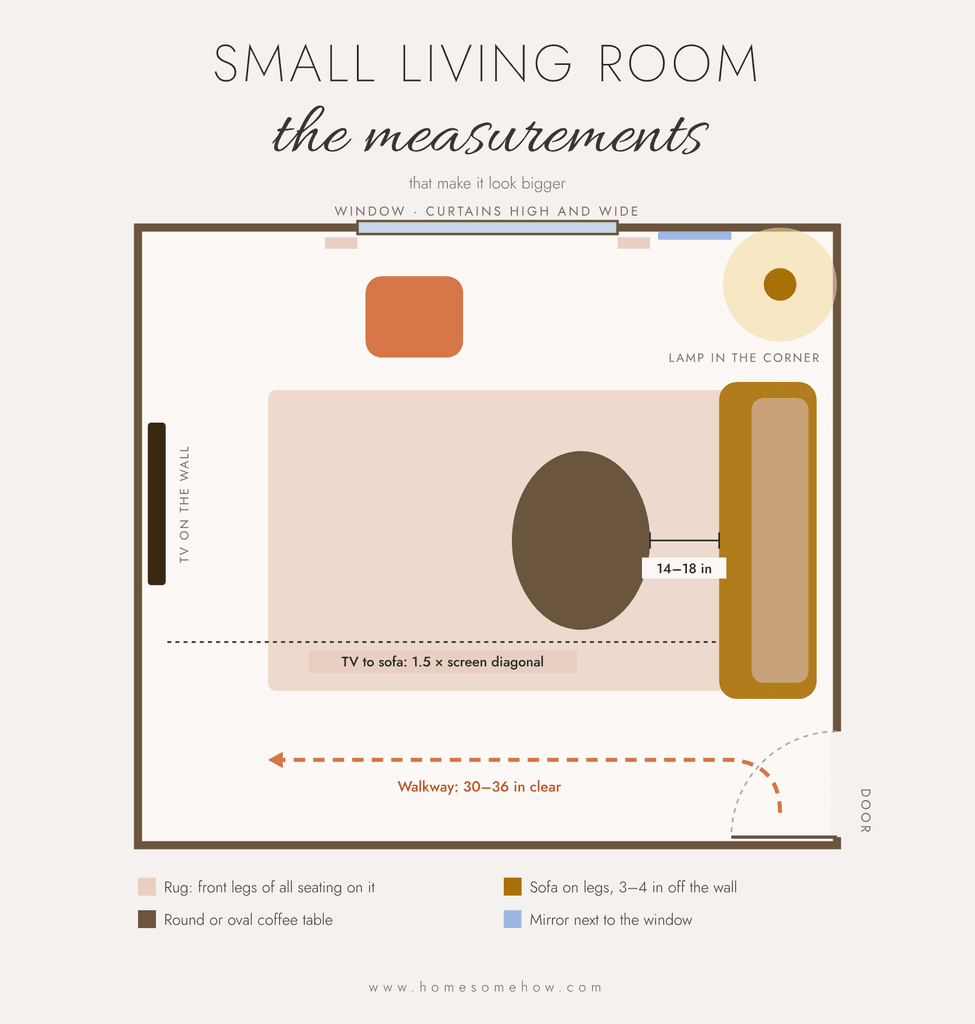
The measurements that make a small living room work.
2. Pull the sofa a few inches off the wall
It sounds backwards, but furniture lined up against every wall leaves an empty, awkward middle and makes the room look like a waiting room. Even 3 or 4 inches between the sofa and the wall creates a sense of depth. If the room allows it, grouping the seating around the coffee table makes a cozy “island” and leaves the edges of the room free.
3. Place the coffee table at the right distance
The usual guideline is 14 to 18 inches between the sofa and the coffee table: close enough to reach a mug, far enough to walk past your knees. In a narrow room, a round or oval table is easier to walk around than a rectangular one, and a nesting table that slides apart when you need it takes up less space the rest of the time.
4. Choose a rug that is big enough
A small rug floating in the middle of the floor makes the whole room look smaller and chopped up. The rug should be large enough for at least the front legs of the sofa and the chairs to rest on it. One larger rug connects the furniture into a single area; several small ones break the floor into pieces.
5. Mind the TV distance
A common rule is to sit at a distance of about 1.5 times the screen’s diagonal: roughly 6 feet for a 50-inch TV. In a small room, that often means a smaller screen, or mounting the TV on the wall instead of using a deep TV stand, which frees up floor space.
Part 2: The furniture
6. Choose furniture with visible legs
When you can see the floor under the sofa, the armchair and the TV unit, the eye reads more floor space. Raised furniture on legs looks lighter than pieces that sit directly on the floor. It is also easier to clean under.
7. Match the scale to the room
A deep sectional can take up half of a small living room. A sofa with slim arms and a seat depth that is not oversized gives you the same number of seats in less space. Measure before buying, and mark the sofa’s footprint on the floor with painter’s tape to see how much room is left.
8. Make furniture work twice
- A storage ottoman is a footrest, extra seat and blanket box.
- A coffee table with a shelf or drawers hides remotes, chargers and magazines.
- A narrow console behind the sofa holds lamps and keys without using wall space.
- A sofa bed turns the living room into a guest room when you need one.
Part 3: Light, color and walls
9. Light every corner
Dark corners make a room feel smaller because the eye stops where the light ends. Instead of one ceiling light, use three light sources at different heights: a floor lamp in a corner, a table lamp beside the sofa and the ceiling light. In the daytime, keep window sills clear and use light curtains that let the sun in.
10. Hang curtains high and wide
Mount the curtain rod closer to the ceiling than to the top of the window frame, and let it extend past the window on both sides. When the curtains are open they cover the wall instead of the glass, so more light comes in and the window, and the ceiling, look taller. Curtains that reach the floor help even more.
11. Use mirrors and a calm palette
- A large mirror opposite or next to a window bounces light around the room and adds a sense of depth. One big mirror works better than several small ones.
- Light walls, such as warm white, soft beige or pale gray, make the edges of the room recede.
- Fewer colors. Two or three colors repeated around the room look calmer and bigger than many different ones. Our fall color guide shows how to choose accents that work with the colors you already have.
- Hang art at eye level, with the center about 57 inches from the floor. Art hung too high makes the wall look emptier, not taller.
12. Go vertical and clear the surfaces
Use the wall height for storage: tall, narrow bookcases or floating shelves take up much less floor than wide, low units. Then keep the surfaces mostly clear. A coffee table with three things on it looks intentional; with fifteen, the whole room looks smaller. A basket for remotes and chargers and a quick tidy every evening keep it that way; see our 15-minute nightly reset.
Common mistakes in a small living room
| Mistake | Why it makes the room look smaller | What to do instead |
|---|---|---|
| All furniture against the walls | An empty center and a “waiting room” feel | Group the seating around the coffee table |
| A small rug | Cuts the floor into pieces | One rug under the front legs of all the seating |
| Lots of small furniture | Visual clutter and blocked paths | Fewer, well-chosen pieces |
| Only a ceiling light | Dark corners | Three light sources at different heights |
| Short curtains at the window frame | A lower-looking ceiling | Rod high and wide, curtains to the floor |
| Every surface decorated | The eye never rests | Leave some surfaces empty |
If you rent
Almost everything here works without changing the apartment: moving furniture, rugs, lamps, mirrors and curtains. For the rest, use tension rods or adhesive hooks for light curtains, lean a large mirror against the wall instead of hanging it, and use freestanding shelves instead of drilling. Check your lease before painting, and keep the original paint color handy if you do.
Common questions
What is the cheapest way to make a small living room look bigger?
Rearranging and clearing it. Free up the walkways, pull the sofa slightly off the wall, take everything off the surfaces that does not need to be there and add a lamp to the darkest corner. None of that costs anything.
What color makes a small living room look bigger?
Light, warm neutrals such as warm white, soft beige or pale gray reflect more light. Painting the walls and the trim in the same or similar color also helps, because the edges of the room become less visible.
Should a small living room have a big or small sofa?
One right-sized sofa is better than a large sectional or several small chairs. Look for slim arms, visible legs and a seat that is not too deep, and mark its size on the floor with tape before you buy.