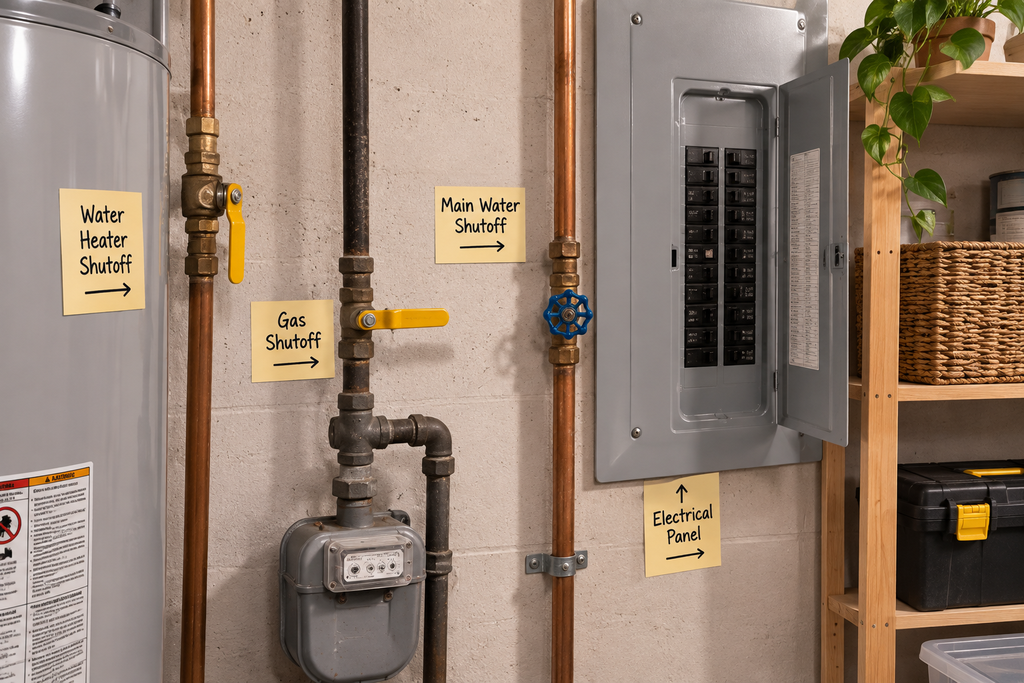
An emergency is the worst time to discover that you do not know how to stop water, identify the correct circuit, or tell a utility worker where a service enters your home. A few minutes spent locating and documenting these controls now can save time when something goes wrong.
The goal is not to experiment with unfamiliar equipment. It is to know what each shutoff controls, where it is located, how to reach it, and who should operate it. That distinction matters most with gas and electricity, where an incorrect action can create a more serious hazard.
This guide explains how to find and label the main water shutoff, smaller plumbing valves, the electrical panel and main disconnect, and the gas service location. Homes vary by age, region, construction, and utility provider, so treat common locations as starting points rather than universal rules.
Which Emergency Controls Should You Know?
Most homeowners should be able to identify the following controls if their property has them:
| Control | What it affects | Where to look first | What to record |
|---|---|---|---|
| Main water shutoff | Water supply to most or all of the home | Where the water line enters the building, basement, crawl space, garage, utility room, or exterior wall | Wide photo, close photo, exact location, valve condition |
| Fixture shutoff | One sink, toilet, appliance, or plumbing fixture | Beneath sinks, behind toilets, or in an appliance connection box | What it serves and whether there are separate hot and cold valves |
| Electrical panel | Individual circuits and sometimes the whole-home main breaker | Garage, basement, utility room, hallway, closet, or exterior service area | Panel location and accurate circuit directory |
| Exterior service disconnect | Whole-home electrical service in some properties | Near the electric meter or exterior service equipment | Location only; do not open unfamiliar equipment |
| Gas service shutoff | Natural gas supply | At or near the gas meter, usually outside or in a utility area | Location and utility contact information |
| Propane shutoff | Propane supply | At the tank or equipment specified by the supplier | Supplier instructions and emergency number |
Your property may also have controls for a well pump, irrigation system, fire sprinkler, sump pump, pool, generator, or water treatment equipment. Add them to your records only after confirming what they control. A label that is based on a guess is worse than no label at all.
Start With the Main Water Shutoff
For many homeowners, the main water shutoff is the most useful control to locate first. If a supply pipe breaks or a connection fails, stopping the flow can limit additional water damage while help is arranged.
Begin by finding where the water service line enters the building. In homes with basements or crawl spaces, the valve is often near the foundation wall on the street-facing side of the property. In other houses, it may be in a garage, utility room, laundry area, mechanical closet, or near the water heater. In warm climates, it may be outside near an exterior wall or meter area.
A main shutoff commonly uses either a lever-style ball valve or a round wheel-style gate valve, but appearance varies. Do not assume that the first valve you see controls the entire home. Pipes may also serve irrigation, fire sprinklers, water treatment equipment, or only one part of the property.
Look at the home inspection report, seller information, plumbing records, or builder documents if the location is not obvious. A plumber or the local water utility may also be able to help identify the correct control. If the property has no accessible homeowner-operated main shutoff, ask a qualified plumber whether one should be installed.
Do not confuse the home shutoff with the utility valve
Some homes have a meter box or curb stop near the street or property line. That equipment may belong to the water provider and may require a special key or authorization. Rules differ between utilities, so do not open, force, or operate street-side equipment unless the provider has confirmed that homeowners may do so and has explained the correct procedure.
Your home’s interior or private-side main shutoff is normally the more practical control for household emergencies. If you cannot find one, contact the water utility or a plumber before an emergency occurs rather than assuming the meter valve is yours to use.
Be cautious with old or corroded valves
A neglected gate valve can seize, leak around the stem, or fail to close fully. A metal handle may also be weakened by corrosion. Do not apply excessive force or use a tool for extra leverage simply to test it.
If the valve looks heavily corroded, is surrounded by moisture, lacks a handle, or cannot be identified confidently, leave it in its current position and arrange an evaluation. A plumber can confirm whether it works and whether replacement is advisable without turning a preparation task into a new leak.
Find the Smaller Water Shutoffs
Not every plumbing problem requires shutting off water to the entire house. Many fixtures and appliances have local valves that isolate only the affected supply.
Sink shutoffs are commonly found beneath the basin. There may be one valve for cold water and another for hot. A toilet supply valve is usually behind or beside the toilet near the wall or floor. Washing machine valves are often located in a wall box behind the appliance, while refrigerator and dishwasher shutoffs may be beneath a nearby sink, behind the appliance, in a basement below, or along the supply route.
Do not pull out a heavy appliance or disconnect a gas, electrical, drain, or water connection just to search for a valve. Check accessible areas first, review installation documents, or ask a professional during the next appropriate service visit.
Label local valves with the exact fixture they control. “Kitchen sink — hot” is more useful than “water.” If two similar bathrooms share a wall, identify the room clearly, such as “upstairs hall bathroom toilet.” Precision prevents someone from closing the wrong valve during a leak.
Locate the Electrical Panel and Main Disconnect
The electrical panel distributes power through individual circuit breakers or, in older systems, fuses. It may be in a garage, basement, hallway, utility room, closet, or on an exterior wall. Some properties also have a separate service disconnect near the electric meter.
Finding the panel does not require removing its cover. Open only the normal hinged access door if the panel appears dry, intact, and safe. Inside that door, you may see a large main breaker and rows of smaller branch-circuit breakers. Not every panel contains the main service disconnect, so do not assume that the largest visible switch is the only whole-home control.
Stop and contact an electrician or the utility if the panel is wet, damaged, unusually hot, buzzing, sparking, missing protective parts, or producing a burning smell. Do not stand in water, touch electrical equipment with wet hands, or approach a panel when water may have reached energized components.
Improve the circuit directory without guessing
Many breaker panels contain vague labels such as “lights,” “plugs,” or “bedroom.” Others were labeled years before renovations changed the circuits. An accurate directory should identify areas and fixed equipment clearly—for example, “primary bedroom outlets” or “dishwasher”—without covering required manufacturer or safety markings.
You can note obviously labeled circuits, but do not claim certainty when you have not verified them. If the directory is incomplete or confusing, a qualified electrician can map the circuits and confirm the main disconnect. Repeatedly tripping breakers, double-tapped connections, damaged panel components, and internal wiring are not labeling projects.
Use a durable directory that fits in the location intended by the panel manufacturer. Avoid placing loose paper where it could interfere with the door or equipment. Never attach labels over ratings, warnings, model information, or inspection markings.
Know Where the Gas Service Is Without Practicing on It
If the home uses natural gas, locate the gas meter and identify the service area from a safe distance. Meters are often outside, although placement varies by region and building type. Propane systems have different equipment and should be documented according to the supplier’s instructions.
The purpose of this step is awareness, not a practice shutoff. Gas utilities may have specific rules about when a customer should operate a valve, and restoring service can require the utility or a qualified professional to inspect the system and relight appliances. Follow the instructions of the provider serving your address rather than a generic online diagram.
If you smell a sulfur-like or rotten-egg odor, hear hissing or whistling, see a damaged gas line, or otherwise suspect a leak, leave the area immediately. Do not use switches, phones, appliances, flames, vehicles, or anything that could create a spark near the suspected leak. From a safe location, call 911 and the gas utility’s emergency number. Do not remain inside to find the meter or read a label.
Keep the utility’s emergency number in your phone and home records. A tag near the meter should identify it as gas service, but it should not contain improvised operating instructions. If a utility or qualified professional has provided property-specific instructions, record their source and date.
How to Label Shutoffs Clearly and Safely
A useful label answers one question immediately: What does this control? It does not need to contain a miniature repair tutorial.
Use plain, specific language. “MAIN WATER — WHOLE HOUSE” is clearer than “VALVE A.” Local labels should identify the room, fixture, and hot or cold supply when relevant. For an electrical panel, use the directory format intended for the equipment rather than hanging tags from breakers.
Choose labels that suit the environment. Paper may be adequate inside a dry document folder but can become unreadable in a damp basement or outdoor area. Water-resistant tags, permanent labels, or protected cards are more appropriate where moisture is possible. Secure them without obstructing movement, ventilation, handles, covers, meters, required clearances, or official utility markings.
Color can make labels easier to notice, but it should never carry the meaning by itself. Someone with color-vision differences, a person working in low light, or an emergency responder unfamiliar with your system still needs readable words. Use the same naming in the physical label, photograph, and household record.
Do not add “turn clockwise,” “pull down,” or similar directions unless a plumber, electrician, utility, manufacturer, or other qualified source has verified that instruction for the exact equipment. Valves and disconnects vary, and an incorrect direction can waste time or cause damage.
What a good label looks like
A strong label might read:
MAIN WATER — WHOLE HOUSE
Basement utility wall, beside the water meter
Confirmed by: ABC Plumbing, May 2026
A local valve could read:
UPSTAIRS HALL BATHROOM — TOILET SUPPLY
The label remains short, but it identifies the control precisely. Detailed photographs, phone numbers, and notes belong in the home record rather than on a crowded tag.
Create a Simple Emergency Shutoff Map
A shutoff map is more useful than a collection of close-up photographs that show no surrounding context. For each control, take one wide photo that shows the route or room and one close photo that shows the valve, panel, or meter. Rename the files immediately so they do not disappear among ordinary phone photos.
Record the exact location, what the control serves, identifying features, access notes, and the date it was confirmed. If a professional or utility identified it, record that as well. Do not write that a control “works” unless its condition was actually assessed.
The following format is enough:
| Control name | Exact location | What it controls | Identification confirmed by | Photo saved as | Last reviewed |
|---|---|---|---|---|---|
| Main water shutoff | Basement north wall, beside meter | Whole-home water supply | Licensed plumber | main-water-basement.jpg | May 2026 |
| Hall bathroom toilet valve | Behind toilet, left side | Toilet cold-water supply | Visually identified | hall-bath-toilet.jpg | May 2026 |
| Electrical panel | Garage east wall | Branch circuits; main location to be confirmed | Electrician appointment scheduled | panel-garage.jpg | May 2026 |
Keep a digital copy where responsible household members can access it and a simple printed copy in a logical, dry location. Do not publish photographs that reveal security details, utility account information, serial numbers, or the layout of your home.
Keep Every Control Accessible
A correctly labeled shutoff is of little use if someone must move shelving, holiday decorations, or heavy boxes to reach it. Maintain a clear route and the working clearance required for the equipment. Electrical panels in particular should never become the back wall of a packed storage area.
Do not paint over valves, panel doors, meter markings, or labels. Avoid hanging objects from pipes or handles. If a shutoff is hidden behind a finished wall, fixed cabinet, or heavy appliance, ask a qualified professional how safe permanent access should be provided.
Review the labels after renovations, appliance replacements, plumbing work, or changes to the electrical system. A label that was correct before a remodel may no longer describe the current installation.
Make Sure Other People Can Find Them
Show every responsible adult where the main water shutoff, electrical panel, and gas meter or propane equipment are located. Explain the difference between knowing a location and being authorized or prepared to operate the control.
If a house sitter, older teenager, tenant, or nearby trusted person may respond while you are away, give that person only the information appropriate to their role. At minimum, they should know how to report a problem, where to find the emergency contact numbers, and when to leave the property rather than attempt a shutoff.
Renters should ask the landlord or property manager which controls are accessible to residents and what procedure to follow. Shared buildings may have central systems that tenants must not operate. Keep the emergency maintenance number somewhere available even if the main shutoff is outside the unit.
What to Do When You Cannot Identify a Shutoff
Do not solve uncertainty by turning several valves or breakers to see what happens. Start with documents: the inspection report, builder plans, appliance manuals, seller information, and utility records. Then contact the organization responsible for the system.
For water, that may be a licensed plumber or local water provider. For electrical service, use a qualified electrician or the electric utility. For natural gas or propane, contact the relevant supplier. Tell them that you want to identify and document the control before an emergency, not that an active emergency is occurring—unless one actually is.
This is also the right time to address missing access, illegible circuit directories, valves that appear deteriorated, or controls hidden by remodeling. Correct identification by a professional can be added to the service visit record and reflected in your labels and photographs.
How Emergency Shutoffs Relate to Common Problems
Knowing the controls helps you respond, but the safest action depends on the event.
For an accessible plumbing leak, a verified fixture valve may isolate the affected sink, toilet, or appliance without interrupting the entire home. A large supply leak may require the verified main water shutoff. If water is near electrical equipment, outlets, or standing water, do not enter or touch the electrical system; leave the area and call emergency services or the appropriate professional.
For an electrical problem, an accurately labeled branch breaker can help a qualified person identify the affected circuit. A breaker that trips repeatedly is reporting a problem, not asking to be reset over and over. Stop using the affected equipment and arrange an electrical evaluation.
For a suspected gas leak, evacuation comes before locating or operating anything. Leave immediately and call from a safe place.
These boundaries are why preparation focuses on identification. A clear label and a good photograph reduce confusion without encouraging unsafe experimentation.
Frequently Asked Questions
Where is the main water shutoff in a house?
It is often near the point where the water service enters the building. Common starting places include a basement, crawl space, garage, utility room, mechanical closet, laundry area, or exterior wall. Climate and construction affect placement, so check the inspection report or ask the water utility or a plumber if it is not obvious.
What if my home does not have an accessible main water valve?
Do not assume that the curb stop or meter valve is available for homeowner use. Ask the local water provider which equipment belongs to the utility, then consult a qualified plumber about installing or replacing an accessible private-side shutoff when appropriate.
Should I test a water shutoff valve?
Do not force or casually operate a valve that is old, corroded, leaking, difficult to identify, or connected to an unfamiliar system. A plumber can confirm its function and condition. If a verified valve is intended for homeowner use, follow the property-specific guidance you receive rather than generic instructions.
Should I test the gas shutoff?
No. Locate the meter and obtain instructions from the gas utility, but do not shut off the gas as a practice exercise. If you suspect a leak, leave immediately and contact 911 and the utility from a safe location.
Can I label my own breaker panel?
You can maintain a clear circuit directory, but every entry should be accurate. Do not remove the panel cover, touch internal components, cover required markings, or investigate a damaged panel. Ask a qualified electrician to map confusing circuits or confirm the main disconnect.
How often should shutoff labels be reviewed?
Review them after plumbing, electrical, gas, appliance, or renovation work and whenever a label becomes loose, faded, blocked, or difficult to read. It is also sensible to look over the map periodically with the other responsible adults in the home.
Preparation Should Reduce Confusion, Not Create Risk
You do not need to become a plumber, electrician, or gas technician to prepare your home. You need reliable information.
Start with the main water shutoff, then identify the smaller fixture valves, electrical panel, main disconnect location, and gas or propane service that apply to the property. Label each control with what it serves, take both wide and close photographs, keep access clear, and share the information with the household.
If a location or function remains uncertain, leave it uncertain in your notes until a utility or qualified professional confirms it. An honest “not yet verified” is safer than a confident but incorrect label.
The best emergency shutoff guide is not the one with the most instructions. It is the one that helps the right person find the right control quickly and makes it equally clear when everyone should step away and call for help.