A small attic can hold a surprising amount, which is both its advantage and its problem. The first few boxes fit easily. Then holiday decorations move behind luggage, small containers disappear beneath larger ones, and the only route to the back becomes a narrow gap that requires moving five things at once.
That is not efficient storage. It is delayed unpacking.
The goal is not to find a use for every inch beneath the roof. It is to create a space where appropriate belongings remain protected, visible, and reachable without blocking the attic itself. A clear path, an empty area in front of a container, and access to building components are not wasted space. They are part of the storage system.
This guide uses three decisions: Suitability → Reach Zones → Clear Path. First decide whether the attic and each item are suitable for storage. Then place belongings according to how often they are needed. Finally, preserve the route and working space required to retrieve them safely.
First Decide Whether the Attic Is Suitable for Storage
“Attic” can describe very different spaces. One may be finished, conditioned, and designed for regular access. Another may contain exposed insulation, framing, wiring, ducts, and no storage-rated floor. Advice that works in the first could be unsafe in the second.
Before bringing up shelving or containers, answer four questions:
- Is there a safe entrance and adequate lighting?
- Is there a clearly established walking and storage surface?
- Does the space remain reasonably dry and free from pest activity?
- Can all vents, equipment, wiring, flues, and other building components remain accessible?
If any answer is unclear, pause the project. An appropriate qualified professional can assess conditions that an organization article cannot determine remotely.
Do Not Treat Exposed Framing as a Finished Floor
Walk only on a surface intended for access. Ceiling drywall and insulation are not walking surfaces, and navigating exposed joists while carrying a bin creates a serious fall risk. Do not assume that adding plywood automatically makes the framing suitable for storage or that an existing platform can accept concentrated heavy loads.
Capacity depends on the structure, span, materials, condition, and original design. Keep especially heavy collections—books, records, tools, tiles, exercise weights, or filled document boxes—elsewhere unless the storage area has been properly evaluated.
Inspect Before You Cover the Evidence
An empty attic reveals problems that boxes can hide. From the designated access area, look for water staining, damp insulation, musty odor, visible growth, pests, or damaged wiring. Do not disturb questionable insulation, nests, droppings, wiring, or suspected mold.
Water and moisture problems should be corrected before storage returns. Putting clean bins over a damp surface does not solve the source, and sealing damp belongings inside plastic can trap moisture with them.
Protect Ventilation and Service Access
Do not place containers against or over soffit vents, roof vents, fans, ducts, flues, recessed fixtures, electrical components, shutoffs, or mechanical equipment. Required clearance varies by the component and local rules, so follow manufacturer guidance and professional instructions rather than inventing a universal gap.
Leave enough working space for future inspection and repair. If a technician must empty half the attic to reach equipment, the layout is using service space as storage.
Declutter Before You Design the Layout
Organization cannot make unnecessary possessions smaller. Before measuring for bins, bring the existing contents into visible groups and decide what deserves attic space.
Use four destinations:
- Keep in the attic: appropriate for the conditions and likely to be used again.
- Keep somewhere else: valuable or sensitive, or needed too frequently for attic access.
- Donate or sell: useful but no longer relevant to the household.
- Dispose or recycle: damaged, expired, unsafe, or unusable, following local requirements.
Make decisions at the category level. If six partly filled boxes contain holiday decorations, bring the category together before deciding how many containers it needs. Otherwise, you may buy six new bins for items that would fit comfortably into three.
Be honest about “just in case.” Replacement cost, likelihood of use, storage risk, and retrieval effort all matter. A cheap object unused for eight years is not free if it occupies the attic’s best space.
Decide What Actually Belongs in an Attic
An unfinished attic can experience much greater temperature and humidity swings than the living area. A lid may block dust, insects, and minor incidental moisture, but it does not create a climate-controlled environment.
When the attic is safe and dry, reasonable candidates may include durable seasonal decorations, empty luggage, artificial wreaths, fully dry outdoor textiles, tolerant camping accessories, and sturdy household items used infrequently.
The word durable matters. Two objects from the same category may need different homes. A basic plastic ornament may tolerate attic storage; a wax ornament, antique glass piece, or irreplaceable handmade decoration may not.
What You Should Avoid Storing in a Hot or Unconditioned Attic
Conditions vary, so this is a decision guide rather than an absolute list. Prefer stable indoor storage for belongings that are valuable, irreplaceable, combustible, pressurized, edible, or sensitive to heat and humidity.
| Item type | Why the attic may be unsuitable | Better approach |
|---|---|---|
| Important documents, photographs, albums, and negatives | Heat, humidity, pests, and water can accelerate permanent damage | Use an appropriate stable indoor location and archival-quality protection |
| Electronics, batteries, and media | Temperature extremes and moisture can damage components or cause leakage | Store indoors within manufacturer conditions |
| Candles, crayons, cosmetics, and wax decorations | Heat can soften, melt, separate, or deform them | Keep in a cooler indoor cabinet |
| Paint, solvents, fuel, aerosols, and chemicals | Products have specific temperature, ventilation, and fire-safety requirements | Follow the label and local household-hazardous-waste guidance |
| Food, pet food, and seed | Can attract pests and deteriorate in heat or humidity | Use sealed storage in an appropriate pantry or utility area |
| Leather, delicate fabric, instruments, and fine furniture | Humidity and heat can warp, dry, stain, or encourage growth | Choose a stable indoor environment |
| Medicine and temperature-sensitive supplies | Effectiveness and safety can depend on labeled storage conditions | Follow the product label exactly |
| Irreplaceable keepsakes | Even a low-probability leak or pest problem can cause an unacceptable loss | Reserve protected indoor space for the most meaningful pieces |
Cardboard is inexpensive, but it absorbs moisture, crushes, hides contents, and can be vulnerable to pests. If used, keep it clean, dry, off questionable surfaces, and easy to inspect.
Measure the Usable Space, Not Just the Floor
A small attic is a three-dimensional shape. Record the access opening, route width, floor area, headroom changes, roof slope, and fixed components. Measure the hatch or doorway too: a perfect bin is useless if it cannot pass through.
Divide the space into four physical areas:
| Physical area | Best use | Avoid |
|---|---|---|
| Full-height area | Standing, turning, opening containers, limited stable shelving if appropriate | Filling it with bulky items simply because they fit |
| Low eaves | Low-profile bins or durable long items that can slide out safely | Tall stacks, fragile objects, or items needing frequent access |
| Awkward corners | One clearly defined rare-use category | Loose miscellaneous objects |
| Service or ventilation area | Inspection, airflow, and technician access | Any storage that covers, crowds, or conceals components |
On a finished storage floor, use painter’s tape—or make a paper sketch—to mark the path and bin footprints. This reveals layouts that leave no room to turn or open a lid.
Create Hot, Warm, and Cold Reach Zones
These names describe frequency of access, not the attic’s temperature. The harder an area is to reach, the less often you should need what is stored there.
Hot Zone: Closest and Easiest to Reach
The Hot Zone begins near—but never in—the entrance. Use it for luggage, current-season equipment, a guest air mattress, or other items retrieved several times a year. Containers should be manageable and identifiable from the path. Never let the hatch become a temporary drop zone.
Warm Zone: Predictable Seasonal Access
The Warm Zone suits categories used once or twice a year: Christmas decorations, Halloween decor, outdoor accessories, or camping equipment. Group each season, place the next one in front, and rotate the order when items return.
Cold Zone: Rarely Retrieved
The farthest appropriate location is for durable objects rarely needed. Every Cold Zone bin still requires a specific label, inventory, and removal route. Do not place valuable keepsakes there merely because they are rarely used: frequency determines accessibility, while sensitivity determines whether something belongs in the attic.
Keep the Center Open
Pushing storage toward usable perimeter zones can make a small attic feel larger, but the center should not become leftover space waiting to be filled. It performs three jobs: movement, visibility, and retrieval.
A path should connect the entrance to each storage section and service component. It must allow a bin to be carried without sidestepping unstable stacks. Leave a working area where one container can be set down and opened.
This changes the definition of capacity. The attic is full when adding another container would remove safe access—not when no bare surface remains.
Use Low Eaves Without Creating a Hidden Tunnel
Sloped ceilings are well suited to low, wide containers, but depth can work against you. If four bins sit in a line under the eaves, the back one is not genuinely accessible.
Use a single-depth row where possible. In deeper areas, keep one category together and make front bins easy to move. Low containers with secure lids and end labels work better than tall tubs whose labels face the roof.
Low-area candidates may include artificial garland, durable seasonal textiles, empty suitcases, folding decorations, and protected wreaths. Contain long flat items so they cannot slide into the path or damage insulation.
Do not attach hooks, tracks, or suspended storage to visible rafters or trusses. Structural members are not blank walls; loading or altering them needs appropriate assessment.
Choose Containers by Footprint and Handling, Not Appearance
Matching bins can simplify stacking, but buying a set before measuring often wastes space. Choose containers only after you know:
- the maximum dimensions that fit through the access opening;
- the height available at its assigned location;
- whether it can be lifted safely when full;
- which side will face the path;
- how the contents respond to attic conditions.
Clear bins reveal changing inventories; opaque bins reduce light and visual distraction. Either works with a specific label. “Christmas” still requires searching, while “tree lights + extension cords” identifies a retrieval target.
Label the short end and long side. Give each bin a code—such as HOL-01—and keep a phone note with its contents and zone. This prevents duplicate purchases and unnecessary opening.
Avoid one enormous bin for a whole category. Several medium containers organized by function are easier to handle and revise.
Organize Awkward Attic Items Deliberately
| Awkward item | Practical storage approach |
|---|---|
| Luggage | Store clean and dry in the Hot Zone if used regularly. Label anything nested inside and keep the combined case manageable. |
| Wreaths | Use a rigid box when shape matters. Hang only from a system designed for storage—never from wiring, ducts, pipes, or framing. |
| Seasonal clothing and bedding | Wash and dry fully, confirm the material tolerates attic conditions, and avoid damaging compression. Keep delicate pieces indoors. |
| Holiday decorations | Divide by use—tree, mantel, exterior, table, or lights—and protect fragile pieces inside each bin. |
Organize Without Buying a Room Full of Bins
Start with a no-purchase layout. Inspect existing containers, match them to categories, and test their footprints. Clean suitcases can hold travel accessories, fitted original boxes may protect certain decorations, and shallow containers may suit the eaves better than new tubs.
Buy only to solve a named problem: “the wreath loses shape,” “the lights tangle,” or “this box is too heavy.” A problem-based list produces fewer, better containers than a plan for visual uniformity.
Shelving can improve visibility when the attic has a suitable floor, clearance, and installation plan. In an unfinished attic it still adds load and may obstruct structure, ventilation, or service access. Get qualified advice when suitability is uncertain.
A Practical Layout for a Small Attic
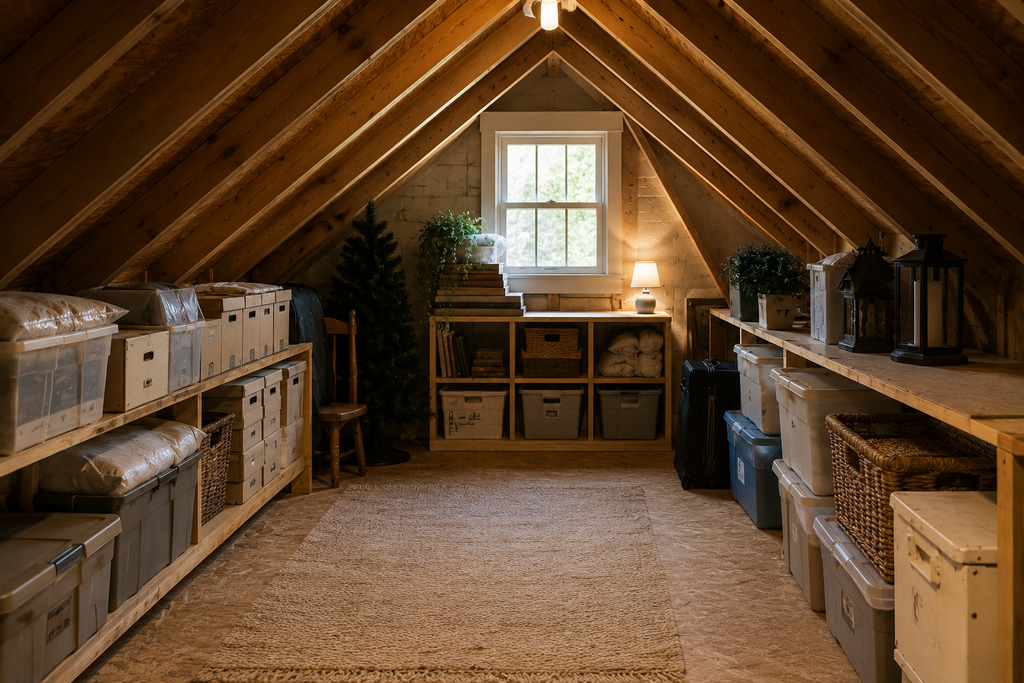
Imagine an attic reached by a front hatch, with standing height along the ridge and low eaves on both sides. A path runs beneath the ridge to the back, beginning with an open landing area. Luggage sits just beyond it in the Hot Zone and can leave without disturbing other categories.
Shallow, end-labeled bins under the first eaves form the Warm Zone for Christmas, Halloween, and durable summer accessories; the next season sits closest. The back perimeter holds a small inventoried Cold Zone. Ventilation and service areas remain clear, and the center has room to carry, turn, and set down one bin.
This plan does not use every cubic foot. It uses every appropriate area while preserving the space that makes the system usable.
Common Small Attic Organization Mistakes
| Mistake | What happens | Better decision |
|---|---|---|
| Buying containers before measuring | Bins do not fit the hatch, slope, or layout | Measure access, height, and footprints first |
| Filling the center | Retrieval becomes a moving puzzle | Treat the path and opening area as permanent |
| Stacking too high | Lower items become inaccessible and stacks unstable | Use manageable containers and appropriate shelving only where suitable |
| Creating a miscellaneous corner | Unlabeled objects accumulate without a retrieval logic | Give every item a category and zone |
| Storing sensitive belongings in sealed tubs | The tub blocks dust but not damaging heat or humidity | Move sensitive items to stable indoor storage |
| Hiding service components | Inspection and repair require major clearing | Preserve visible, usable access from the start |
| Putting frequent items at the back | Every visit disturbs the whole attic | Assign zones by access frequency |
| Concentrating heavy items | A small footprint receives unnecessary load | Relocate heavy collections and confirm capacity when needed |
Keep the Attic Organized as Categories Change
Review the attic at seasonal transitions. When decorations return, confirm they are clean and dry, remove broken pieces, update labels, and move the next season forward.
Use a one-category-in, one-category-review rule. If camping gear grows, review that zone before it spills into Christmas storage. A new bin without a planned footprint requires editing or redesign—not space in the path.
After severe weather or any known roof, plumbing, ventilation, or pest problem, inspect the storage area when it is safe to do so. A sealed container can conceal exterior moisture, staining beneath it, or damage behind the stack.
Keep a photo of the layout and inventory on your phone. It guides returns and exposes “temporary” additions consuming working space.
Frequently Asked Questions
How do I maximize storage in a small attic?
Maximize usable capacity by keeping the center clear, assigning low eaves to suitable low-profile containers, and placing items according to access frequency. Do not maximize the raw volume at the expense of safe walking, ventilation, service access, or retrieval space.
What is the best way to organize an attic with sloped ceilings?
Map the changes in height before buying storage. Use low, end-labeled bins along appropriate eave areas, preserve the full-height section for movement and access, and avoid deep rows that hide containers behind one another.
What should I store under low attic eaves?
Choose durable, lightweight, infrequently accessed items that tolerate the attic conditions. Artificial seasonal decor and certain clean, dry textiles may work. Do not push valuable, fragile, or sensitive objects into the eaves simply because they fit.
Are plastic bins good for attic storage?
They can protect suitable contents from dust, pests, and limited incidental moisture, and clear versions improve visibility. They do not protect against temperature extremes or high humidity. Pack only clean, completely dry contents and inspect bins periodically.
Should I add shelves to an unfinished attic?
Only when the attic has a suitable storage surface, the load and installation are appropriate, and the shelves will not obstruct components or ventilation. Do not attach storage to rafters or trusses or add flooring without understanding the structural implications.
How much empty space should I leave?
There is no universal percentage. Leave a continuous safe route, room at the entrance, space to carry and set down a container, and the access required around building components. If another bin removes one of those functions, the attic has reached its practical capacity.
The Space You Leave Empty Makes the Attic Work
Good organization begins with limits: the attic must be suitable, the belongings must tolerate it, and the layout must protect the building. Put frequent items near the entrance, seasonal groups in the middle, and appropriate rare-use belongings farther back.
Most importantly, stop before every inch is full. The clear path and working area turn a crowded roof space into storage you can actually use.