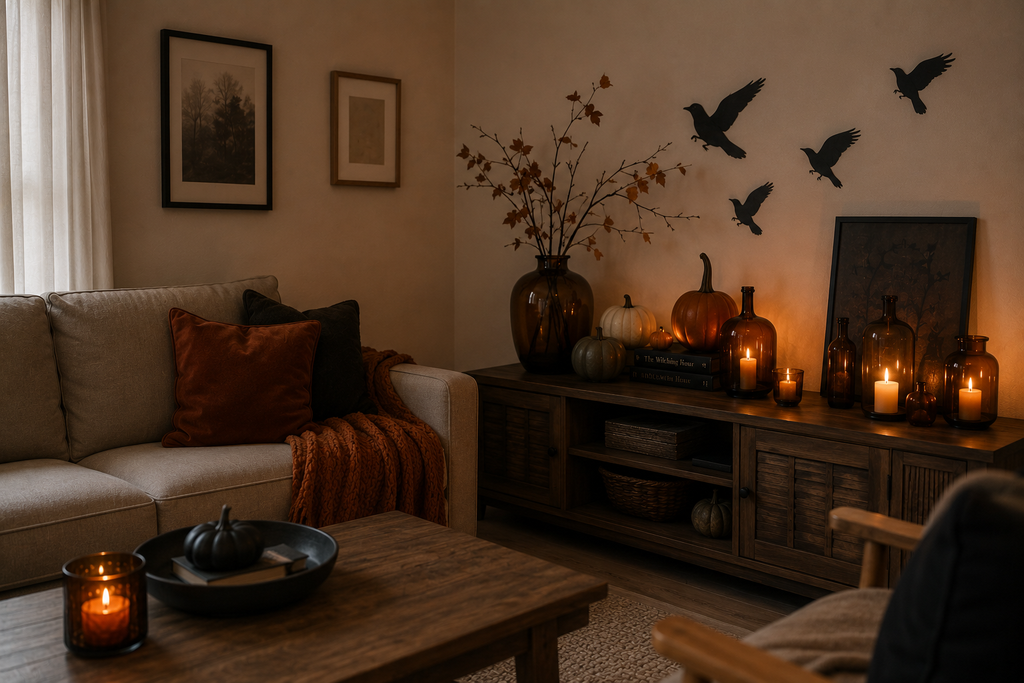
Halloween decorating can become cluttered surprisingly quickly. One ceramic ghost gains a companion, then come miniature pumpkins, webs, signs, bats, skeletons, and special pillows. Soon every surface tells a different spooky story while the house becomes harder to clean and use.
A memorable Halloween home does not need more objects. It needs a clear mood, a few well-chosen locations, and enough contrast for the decorations to be noticed.
Use three decisions: Mood, Route, Limit. Choose the atmosphere, place it where people naturally notice it, and set a physical limit before buying or making anything. The home feels intentionally spooky without producing three new storage bins in November.
Start by Choosing a Halloween Mood
Halloween might mean old-library mystery, cheerful ghosts, classic orange and black, an eerie forest, or vintage monsters. Combining all of those ideas in one small room is what makes decor feel chaotic.
Choose one mood to guide color, materials, light, and motifs. It need not be rigid; it simply helps you reject attractive objects that do not belong together.
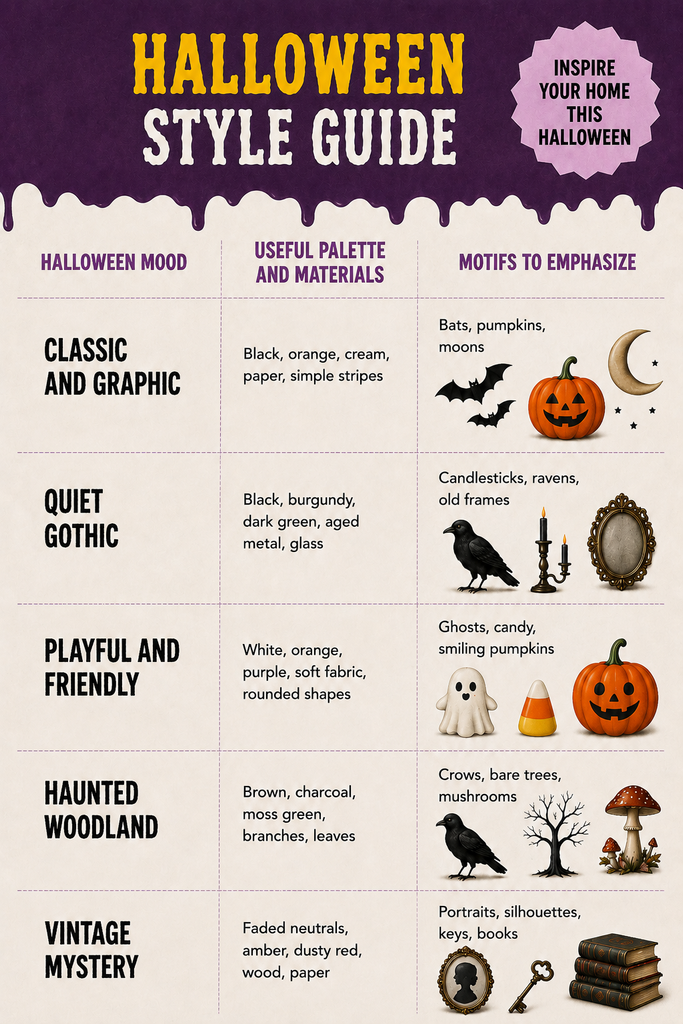
Select one dominant motif and one supporting motif. A haunted woodland home might use branches and a few black birds; it does not also need spiders, ghosts, skulls, witches, and candy corn.
Relate the palette to the home. Burgundy and black may suit dark wood, while cream ghosts and muted orange may fit a lighter interior. The result should feel like a temporary change to your rooms, not an unrelated store display.
Map the Decor Along a Three-Point Route
Think about the route a person experiences rather than counting decorated rooms. Most homes need no more than three noticeable moments.
Point 1: Arrival
The porch, front door, or apartment door establishes the mood. A wreath, two pumpkins, or one lit silhouette can do the work without a complete haunted-house set.
Point 2: Transition
The entryway carries the mood indoors. Flat or vertical decor—temporary framed art, a silhouette, or a dark ribbon on an existing wreath—preserves narrow surfaces and still leaves room for keys.
Point 3: Gathering
Choose the living room, dining area, or whichever space people use together for the most developed display. A studio may need only the door and main room. In a larger home, repeat one color or shape elsewhere instead of building a display in every room.
Build Atmosphere Before Adding Decorations
Objects are only one part of a Halloween setting. Light, shadow, sound, and movement can change a room with almost no physical storage.
Use Existing Light More Deliberately
Use table or floor lamps where appropriate instead of relying only on bright overhead light. Ordinary plants, walls, and lampshades can create more convincing shadows than a shelf of plastic decorations.
If you own color-changing bulbs, choose one restrained setting: amber for candlelit warmth, dim purple for mystery, or low red for theater. Keep stairs, entrances, and walking paths adequately illuminated; spooky should never mean difficult to navigate.
Battery candles work near paper, inside suitable lanterns, and anywhere an open flame is inappropriate. A built-in timer can make several lights easier to manage.
Use Sound as Background, Not Competition
A quiet instrumental playlist, creaking-house soundscape, or old-film soundtrack can establish Halloween in seconds. Match it to the mood, keep it conversation-friendly and considerate of neighbors, and avoid sudden screams near unsuspecting visitors.
Treat Screens as Temporary Decor
A television or digital frame can show licensed seasonal artwork when already in use. Choose a still or gentle image rather than a bright animation running all day. A moonlit landscape or dark botanical scene disappears after October without entering a storage box.
Reuse Ordinary Items and Make Flat Decor Count
Before shopping, collect objects in the chosen palette: a black bowl, dark books, an amber bottle, wooden tray, mirror, glass, or an existing basket. Use reversible changes. A ribbon can alter a vase for a month; a black bowl can hold apples or candy and return to normal use on November 1. Do not use an ordinary food jar for flame unless it is designed and labeled for that purpose.
Flat decor provides broad impact with little storage. Place licensed printable art in an existing frame, replace—not add—one or two pillow covers, or use a dark runner that does not interfere with the table. Keep books intact rather than damaging them as craft materials.
For paper bats, vary two or three sizes and arrange them along one flight path, beginning densely near a frame or doorway and spreading outward. A single window silhouette can have more impact than many unrelated shapes. Test removable adhesive discreetly, follow its surface instructions, and keep paper away from heat, vents, cooking areas, and flame. Never cover an exit, lock, safety notice, or necessary window view.
Decorate With Pumpkins and Other Temporary Materials
Pumpkins create instant Halloween recognition and do not need to be stored, but they still need a plan.
Use fewer pumpkins in varied proportions instead of lining surfaces with miniatures. One large pumpkin beside two smaller ones forms a clear group; indoors, one unusual squash in a dark bowl may be enough.
Keep them on stable, moisture-resistant surfaces and remove any that soften, leak, smell, or show mold. Only plan to eat produce sold for food that remains sound and has not been painted, glued, carved, or otherwise treated.
For branches or leaves, make sure collection is allowed and bring inside only dry pieces free from insects and decay. A contained arrangement is easier to maintain than loose leaves across furniture.
Artificial cobweb can tangle, catch on plants, and create problems outdoors. Keep any use controlled, away from flame and moving equipment, and remove it completely. Paper silhouettes or shadow often look cleaner.
Create a Simple Halloween Porch That Still Works
The porch must establish the mood while helping people approach safely. Decor should not narrow steps, hide changes in level, block handrails or the address, interfere with the door, or place cords across the route.
View it at night, confirm the path and steps remain visible, and select one vertical element plus one ground group. A wreath or branch-filled planter and two stable pumpkins outside the route may be all it needs.
Use lighting labeled for its intended location, follow its instructions, protect connections as directed, and avoid overloaded outlets or extensions. Battery products must still be suitable for outdoor conditions.
Consider the audience: motion props may overwhelm children, animals, or delivery workers. Silhouette, shadow, and color can feel spooky without startling everyone.
In an apartment, use a permitted door decoration and an interior light visible from inside. Follow lease and building rules, especially in shared corridors.
Style One Indoor Halloween Scene
The gathering-area display should look like one scene, not an inventory of everything owned. Choose a surface with enough negative space around it: a mantel, console, bookshelf section, or dining table.
Build it in three layers:
- Background: a frame, mirror, branch silhouette, or removable paper shapes.
- Middle height: books, a vase, lantern, or two candlesticks.
- Low foreground: one pumpkin, small bowl, or contained group.
Height makes a small number of objects feel complete. Three related candles look calmer than five unrelated figurines. Leave part of the surface empty and keep doors, vents, screens, and everyday objects usable.
On a dining table, keep the display low and small enough for plates. If it moves to the counter at every meal, it is movable clutter.
Use Scent Carefully and Sparingly
Scent can extend the mood, but use one subtle direction—woody, apple, spice, or another fragrance the household enjoys—rather than several strong products.
Follow product instructions and consider sensitivities, children, and pets. Do not leave simmering mixtures unattended merely for atmosphere.
Keep real candles in stable holders on uncluttered surfaces, well away from combustibles, children, and pets, and extinguish them before leaving or sleeping. Use flameless candles when safe clearance and supervision cannot be maintained.
Set a Storage Limit Before Buying Halloween Decor
Clutter-free Halloween decor is decided partly in October and partly when everything comes down. Give the collection a defined storage boundary, such as one container that fits an existing shelf. The container is a limit, not a challenge to compress more objects into it.
A useful hierarchy is:
| Storage type | Examples | Best use |
|---|---|---|
| Disappears after the season | Sound, digital art, edible produce, responsibly recyclable paper | Large atmosphere with no permanent volume |
| Stores flat | Pillow covers, runner, silhouettes, paper bats, printable art | Broad visual impact in a small folder or bag |
| Reuses ordinary items | Bowls, jars, books, trays, lamps, baskets | Decor that returns to normal household use |
| Earns three-dimensional space | One favorite figurine, durable lantern, special wreath | Memorable pieces used and enjoyed every year |
Before buying something bulky, identify its exact display and storage locations. If its only qualification is “cute,” photograph it and wait a day; seasonal urgency often creates collections that look less cohesive at home than in the store.
Decorate on a Budget and Know When to Stop
Shop the house first, sorting reusable objects by color and shape rather than normal purpose. An existing bowl, amber vase, dark book, and blanket may provide the foundation. Add paper, licensed printable art, a pillow cover, or one thrifted piece only after identifying a gap. Handmade clutter is still clutter, so make only what will be displayed, stored flat, or recycled appropriately.
Use a simple limit: one mood, no more than three focal points, and one dominant motif. From the doorway, one area should catch the eye first. Then test normal use: the table should hold dinner, the door should open, seating should remain available, and cleaning should not require relocating fifteen objects.
Common Halloween Decorating Mistakes
| Mistake | Why it creates clutter | Better decision |
|---|---|---|
| Mixing several themes | The rooms lack a clear visual story | Choose one mood and two motifs |
| Decorating every surface | Daily functions disappear beneath the display | Concentrate decor at two or three focal points |
| Buying many small figurines | Individual pieces become visual noise | Use fewer objects with varied height and scale |
| Ignoring the approach path | Decor can obscure steps or create trip hazards | Design the porch from the visitor’s route first |
| Using loose web everywhere | It tangles, collects debris, and is difficult to remove | Use controlled sections or flat silhouettes |
| Treating dimness as atmosphere | Walking areas become difficult to see | Keep routes lit and darken only decorative zones |
| Using open flame among paper and fabric | Combustible decor increases the risk around candles | Use safe clearance or flameless lighting |
| Buying without a November plan | Temporary excitement becomes permanent storage | Set the container limit before shopping |
| Keeping decor out of guilt | Unused pieces occupy space every year | Retain what fits the chosen mood and gets displayed |
A Complete Halloween Plan for a Small Home
Imagine a small home with a narrow porch, compact entry, and one combined living and dining room. The chosen mood is quiet gothic, using black, burgundy, amber glass, and branches. The dominant motif is the raven; moons are the smaller supporting detail.
At the door, two pumpkins sit outside the path beside an existing planter with dry branches. Black ribbon changes the regular wreath, while the porch light keeps the steps and number visible.
In the entry, an existing frame holds a temporary moon-and-raven silhouette. The console keeps its key bowl and lamp; no figurines are added.
One bookcase section becomes the gathering focal point. Dark books support an amber bottle and branch; three battery candles vary the height, and paper ravens move toward the wall. A black dining bowl holds apples that will be eaten.
One lamp and a quiet instrumental playlist complete the evening mood, while the coffee table, sofa, dining places, and paths remain usable.
After Halloween, the produce is handled appropriately, digital and sound elements disappear, and flat pieces enter one folder. Ordinary objects return to daily use. Clean and dry reusable decor, remove batteries when directed, protect fragile pieces, and discard or recycle temporary material appropriately. Store only what you want to display again.
Frequently Asked Questions
How can I decorate for Halloween without creating clutter?
Choose one mood, decorate no more than two or three high-impact locations, and use light, sound, temporary materials, and objects you already own. Leave functional surfaces and walking paths clear.
How can I make my home look Halloween-themed on a budget?
Reuse dark bowls, frames, books, jars, textiles, and lamps; add a small amount of paper decor or seasonal produce; and spend only after identifying a specific gap. Cohesion makes inexpensive decor look intentional.
How do I decorate for Halloween in a small home?
Use the door, one vertical wall area, and one main surface. Flat decorations and lighting create impact without consuming floor or counter space. A studio may need only an entrance detail and one living-area focal point.
What Halloween decor is easiest to store?
Pillow covers, fabric runners, paper shapes, printable art, window silhouettes, and other flat pieces require little space. Digital decor and sound require none, while normal household items return to daily use.
How do I make Halloween decor feel spooky but still cozy?
Use a limited dark palette, low but adequate lighting, tactile fabrics, and one quiet motif such as moons, ravens, or branches. Avoid mixing numerous bright colors, loud props, and competing themes.
Create a Mood, Not a Storage Problem
A spooky home does not require a decoration on every shelf. Halloween becomes more convincing when the atmosphere is clear and the objects have room to be noticed.
Choose one mood, map it onto arrival, transition, and gathering points, and decide how much space the collection may occupy after October. Let light, shadow, sound, paper, produce, and ordinary objects do most of the work.
When the home feels different but remains comfortable, safe, and easy to use, the decorating is finished.