
A deep linen closet can hold an impressive amount and still feel unusable. Towels at the front block fitted sheets behind them, toiletries fall over in the middle, and bulky items disappear until the entire shelf is emptied.
The problem is not always a lack of storage. It is inaccessible storage.
That distinction changes the solution. A shallow cabinet can work with one visible row. A deep, narrow closet needs either clearly defined layers or containers that move forward as one unit, plus enough open space to reach and return things comfortably.
The goal is not to fill every inch. It is to make every item you decide to store reasonably easy to find and retrieve.
Why Deep, Narrow Linen Closets Are Difficult to Use
Depth looks valuable, but a narrow doorway gives only a partial view of a long shelf. The front row blocks access, different-sized linens create unstable stacks, and small packages become loose obstacles.
Hidden space also invites people to push awkward or unrelated objects into the back. The closet gradually becomes a holding area instead of a working system.
A functional system therefore has to solve four things at once:
- visibility, so you know what is stored;
- access, so you can reach it without unloading a shelf;
- stability, so folded stacks and bottles stay upright;
- limits, so the available depth does not become permission to keep endless backups.
Begin With the Closet, Not the Organizers
Before buying baskets, remove the contents one shelf at a time. This lets you examine the space without covering the hallway in linens.
Clean each shelf and allow it to dry completely. Look for water staining, peeling paint, condensation, a musty smell, soft drywall, or evidence of a leak. Linens should not be returned to a damp space. If moisture keeps appearing, identify and correct the source rather than trying to hide the smell with fragrance products.
Measure the usable width, depth, and height of every shelf; they may not be identical. Note hinges, trim, shelf supports, and an opening narrower than the interior. Measure the clearance above the front edge too: a bin can fit on the shelf yet be impossible to pull through the doorway without tipping.
Keep these measurements in your phone. They matter later, once you know whether a product would solve a genuine problem.
Decide What Actually Belongs in the Closet
The best contents depend on location. A closet beside the bathroom may hold towels, toilet paper, and personal-care refills; one near the bedrooms may work better for sheets, blankets, and guest bedding.
Start with broad categories that match how the household uses the space:
- bath towels, hand towels, and washcloths;
- sheets and pillowcases organized by bed size;
- current blankets or duvet covers;
- guest linens;
- unopened toiletries and paper supplies;
- a limited amount of seasonal bedding.
Do not add chemicals, tools, medicines, luggage, or unrelated overflow simply because a corner is empty. Store medicines according to their labels in a secure, suitable location; heat and moisture can make a bathroom-adjacent closet a poor default.
When several categories compete for the same space, give priority to items used near the closet. Storing bathroom towels ten steps from the shower is more practical than filling the eye-level shelf with a comforter used twice a year.
Reduce the Volume Before Designing the Layout
No arrangement can make an unlimited linen inventory easy to use. Before folding and labeling, examine duplicates, damaged items, and products that the household consistently ignores.
There is no universal number of towels or sheet sets. Let the time between laundry cycles, household size, and genuine guest needs determine the quantity, plus a reasonable spare.
For example, two usable sets may cover a bed while one is being washed, and an infrequently used guest bed may need one dedicated set. Six incomplete sets create volume without providing six functional choices.
Remove badly frayed, permanently stained, or ineffective towels. Reassign only the few cleaning cloths you will use; keeping every old towel merely moves the excess. Check local donation or textile-recycling rules before passing them on.
Check refills too. Handle expired or damaged products according to their labels and local guidance, and use older open products before newer equivalents when appropriate.
Choose Between Two Depth Strategies
There are two reliable ways to organize a deep shelf. The mistake is combining them randomly.
Strategy 1: Front, Middle, and Back Zones
This works when the front can move easily: everyday towels and current sheets stay in front, a modest number of replacements occupy the middle, and seasonal or guest items retrieved as a group go in the back.
The important word is reserved. If the back becomes a mixture of spare toiletries, unmatched pillowcases, travel items, and extra paper goods, the zoning has failed. Each depth layer needs a clear purpose.
Strategy 2: Full-Depth Pull-Out Storage
This is usually better for loose items. A long container behaves like a drawer, bringing an entire category forward instead of leaving unrelated objects behind a short front basket.
A full-depth bin can work well for toiletries, washcloths, pillowcases, or light bedding. It needs a reachable handle, sufficient clearance, and a sensible weight. A deep bin packed with shampoo bottles may become too heavy to pull safely, even if it fits perfectly.
You do not need to use the same strategy on every shelf. Towels may work in open front-facing stacks, while small bathroom supplies benefit from pull-out storage and a seasonal blanket occupies a labeled bin at the back of the top shelf.
Build the Layout Around Frequency and Weight
Use the easiest shelves—usually between waist and eye level—for frequent items. Keep high storage light and occasional; lower shelves can hold heavier contained items that remain safe to lift.
Here is a practical starting point:
| Closet area | Best use | Avoid |
|---|---|---|
| Top shelf | Seasonal blankets, guest linens, light backstock | Heavy bins, daily towels, loose small products |
| Eye-level shelves | Everyday towels, current sheet sets, frequently used supplies | Rarely used bulky items |
| Waist-level shelves | Extra towels, toilet paper, contained toiletries | Tall unstable stacks |
| Lower shelves | Bulky but manageable bedding, heavier refills in shallow groups | Loose glass bottles or anything difficult to lift |
| Deep back area | Seasonal or guest items in removable groups | Individual everyday products |
| Closet floor | One large, washable, contained category if needed | Loose textiles, paper touching a damp-prone floor, miscellaneous clutter |
Treat this as a decision framework rather than a fixed plan. A short adult, a child, or someone with limited mobility will have a different safe reach zone. The closet should work for the people who actually use it.
Organize Towels Without Building Unstable Towers
Towels are bulky, but they are usually easy to identify and do not always need bins. The main issue is stack height. When ten towels are compressed into one tower, removing a towel from the middle shifts the weight above it and the stack collapses.
Use shorter stacks separated by towel type or user. Bath towels can occupy one section, hand towels another, and washcloths a small open container. Test a temporary boundary with a sturdy box before buying vertical dividers.
Fold for the shelf, not for a photograph. A narrower fold may create two accessible stacks where a wide fold leaves one deep row. Rolling can stabilize towels on a very narrow shelf, but it is not automatically more space-efficient. Compare both shapes with your actual towels.
Place the clean towels most likely to be used next at the front or top of the stack. When returning laundry, rotate consistently enough that the same towels are not left untouched at the bottom for months.
Keep Sheet Sets Together in a Way You Will Maintain
Sheets cause more confusion because fitted sheets, flat sheets, and pillowcases look similar when folded. First separate them by bed size—Twin, Full, Queen, King, or the sizes used in your home. A small label on the shelf edge or container is more useful than relying on memory.
Placing the folded sheets inside a matching pillowcase creates one bundle, but only use that method if it is easy for you to maintain and identify. Alternatively, keep complete sets in a shallow bin labeled by bed size.
Avoid a separate container for every set unless it genuinely simplifies laundry. Too many small bins consume width and add steps. The goal is to retrieve one complete set without searching through several piles.
For households with similar-looking sizes, labels can prevent a frustrating remake of the bed. Mark the shelf, bin, or an unobtrusive corner of the care tag according to an appropriate textile-safe method. Keep manufacturer care labels attached whenever possible.
Turn the Depth Into Pull-Out Storage
A long, narrow bin is useful only if it can travel in and out like a drawer. Before buying one, simulate the idea with a clean cardboard box. Trim it to the approximate dimensions, load it with the intended category, and use it for several days.
The test reveals whether the box catches on the frame, requires two hands, becomes too heavy, hides its label, or is too rigid for a changing category.
If it works, look for straight sides, a front handle, and finger clearance. Clear bins suit mixed supplies; an open basket may be enough for recognizable towels. Label opaque containers, especially above eye level.
Avoid storing different categories in a single extra-long bin merely to use its capacity. If you must unload guest pillowcases to reach shampoo refills, the container has recreated the original problem on a smaller scale.
Use Vertical Space Without Making Access Worse
Use tall gaps only when every layer remains reachable. A stable riser can separate light categories, but a poor fit may wobble, reduce hand clearance, or hide the back row.
Shelf dividers are often more valuable than risers for linens because they support stacks without hiding them. Adjustable shelves can also solve the problem at its source. If the shelf spacing can be changed safely, give bulky blankets more height and reduce empty air above compact categories.
Do not install door storage automatically. A narrow rack may hold light washcloths or small unopened items, but it must not overload the door, strike the shelves, prevent closing, or block the main opening. Check the organizer and door manufacturer’s limits before adding weight.
Store Seasonal and Guest Linens Strategically
Seasonal rotation makes the deepest area useful. I already separate items by season in other storage spaces, and the same principle works here: current bedding stays accessible, while heavy blankets or flannel sheets move back during summer and lightweight extras move back during winter.
Store only clean, completely dry textiles. A container can block dust but also trap residual moisture. Do not compress delicate fills unless their care instructions allow it.
Store guest items as one usable group, such as a complete bed set and pillowcases in a labeled bin. The whole group can then be removed without dismantling the closet.
Revisit seasonal items when you rotate them. If a blanket was not used during the entire relevant season, ask whether it is still worth occupying the least accessible space.
Choose Organizers by Problem, Not Appearance
Matching containers may look calm, but appearance does not prove the storage works. Define the failure first, then choose the smallest intervention that corrects it.
| Actual problem | Possible solution | What to verify |
|---|---|---|
| Small supplies disappear at the back | Full-depth pull-out bin | Handle access, weight, door clearance |
| Towel stacks lean into each other | Vertical shelf divider | Shelf thickness and divider stability |
| Back-row items are shorter than front items | Stable shelf riser | Weight rating, width, remaining hand space |
| Sheet sizes get mixed | Shelf label or one bin per bed size | Labels remain visible from the doorway |
| Bottles tip and leak | Washable shallow tray or divided bin | Bottle height and easy removal |
| Seasonal linens collect dust | Breathable or suitable lidded storage | Fabric care, dryness, container dimensions |
| The top shelf cannot be seen | Clearly labeled front-facing container | Safe lifting weight and reachable handle |
Turntables have a limited role in a deep, narrow closet. They can help with small bottles when the shelf is wide enough for the full circle to rotate, but the round footprint wastes corners and does not use a long rectangular shelf efficiently. Test the rotation and clearance before committing to one.
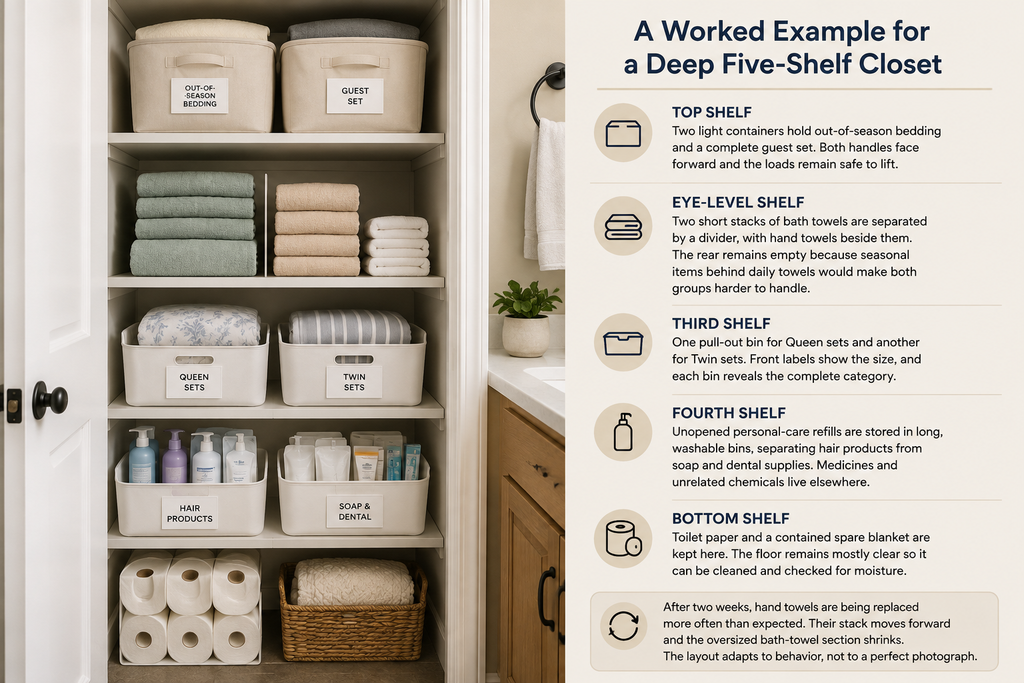
A Worked Example for a Deep Five-Shelf Closet
Imagine a closet that is 20 inches deep but only 24 inches wide, located beside the bathroom. The top shelf holds two light containers: out-of-season bedding and a complete guest set. Both handles face forward and the loads remain safe to lift. The eye-level shelf contains two short bath-towel stacks separated by a divider, with hand towels beside them. Its rear remains empty because seasonal items behind daily towels would make both groups harder to handle.
The third shelf uses one pull-out bin for Queen sets and another for Twin sets. Front labels show the size, and each bin reveals the complete category. The fourth shelf holds unopened personal-care refills in long, washable bins, separating hair products from soap and dental supplies. Medicines and unrelated chemicals live elsewhere. The bottom shelf holds toilet paper and a contained spare blanket. The floor remains mostly clear so it can be cleaned and checked for moisture.
After two weeks, hand towels are being replaced more often than expected. Their stack moves forward and the oversized bath-towel section shrinks. The layout adapts to behavior, not to a perfect photograph.
Protect Linens From Moisture and Odors
Never place damp textiles in a closed closet. Dry them fully, use appropriate bathroom ventilation, and avoid packing shelves so tightly that air cannot move.
A persistent musty smell is not an organization problem. Check for leaks, condensation, stains, or damp walls; remove affected textiles and address the source. Fragrance products may mask an odor but cannot correct moisture.
Store leaking toiletries inside a washable tray and clean spills promptly. Keep products closed and follow their storage directions. If children can access the closet, place unsuitable products out of reach or in secured storage appropriate to the item.
Common Deep Linen Closet Organization Mistakes
| Mistake | Why it fails | Better approach |
|---|---|---|
| Filling all available depth | The front blocks access and the back is forgotten | Leave working space or use removable full-depth groups |
| Storing daily items behind backups | Routine retrieval requires unloading the shelf | Give frequent items the easiest position |
| Building very tall towel stacks | Removing one item destabilizes the pile | Use shorter stacks with clear boundaries |
| Buying bins before measuring | Containers may fit inside but not through the opening | Measure usable dimensions and test with a box |
| Creating a single “bathroom” bin | Unrelated products become a hidden jumble | Use a few broad but meaningful categories |
| Using opaque bins without labels | Every search requires opening several containers | Label from the viewing angle |
| Keeping excessive backups | Organizers disguise inventory rather than reduce it | Set limits based on use and laundry habits |
| Putting heavy storage overhead | Retrieval becomes awkward or unsafe | Keep high storage light and occasional |
Keep the System Working After the Initial Organizing Session
A linen closet should not require a monthly reset. Return clean towels to their stack, keep sheet sets together, and place replacement products behind those to use first.
Use a simple retrieval test: if you repeatedly have to remove more than one unrelated item to reach what you need, that shelf needs adjustment. The solution may be moving the item forward, dividing a category, reducing the quantity, or changing from layered storage to a pull-out bin.
Watch where people naturally leave things. If washcloths always land on the nearest shelf instead of inside a lidded box, the box adds unnecessary friction. A less uniform system that gets used will last longer.
Review seasonal textiles when the weather changes and inspect toiletries when adding replacements. Beyond those moments, reorganize only when the household’s routines, inventory, or needs have changed.
Frequently Asked Questions
How do you organize a linen closet with very deep shelves?
Use defined depth zones or full-depth containers that pull out like drawers. Keep everyday items forward and seasonal or guest items in removable groups at the back.
What should go at the back of a deep linen closet?
The back is best for infrequently used but genuinely necessary items, such as seasonal bedding or a guest-linen set. Avoid putting individual everyday supplies there, even if you label them.
Is it better to roll or fold towels?
Neither is universally better. Short folded stacks are stable, while rolling may suit a narrow shelf or bin. Test both with the actual dimensions.
How should I organize sheet sets?
Separate sets by bed size and keep the fitted sheet, flat sheet, and pillowcases together, either bundled inside a pillowcase or grouped in a labeled bin.
Do I need bins in a linen closet?
No. Open stacks work for recognizable linens. Bins help with loose supplies, similar sheet sets, seasonal groups, or categories that must move forward as one unit.
What belongs on the top shelf?
Use it for light, occasional items such as guest linens or seasonal bedding. Keep handles and labels visible, and avoid heavy containers or daily necessities.
How often should I reorganize a linen closet?
Adjust it when retrieval becomes difficult or household needs change. Seasonal rotation is a natural review point; frequent complete resets should not be necessary.
Make the Space Accessible, Not Merely Full
A deep, narrow linen closet does not need more storage ideas. It needs a clear access strategy.
Decide what belongs, reduce excess, measure the real opening, and assign shelves according to frequency and weight. Choose intentional depth zones or pull-out groups, fold for the shelf, keep sheet sets together, and leave working space.
An organized closet is not one in which every inch is occupied. It is one where a person can open the door, understand what is there, remove what they need, and put it back without creating a new mess.